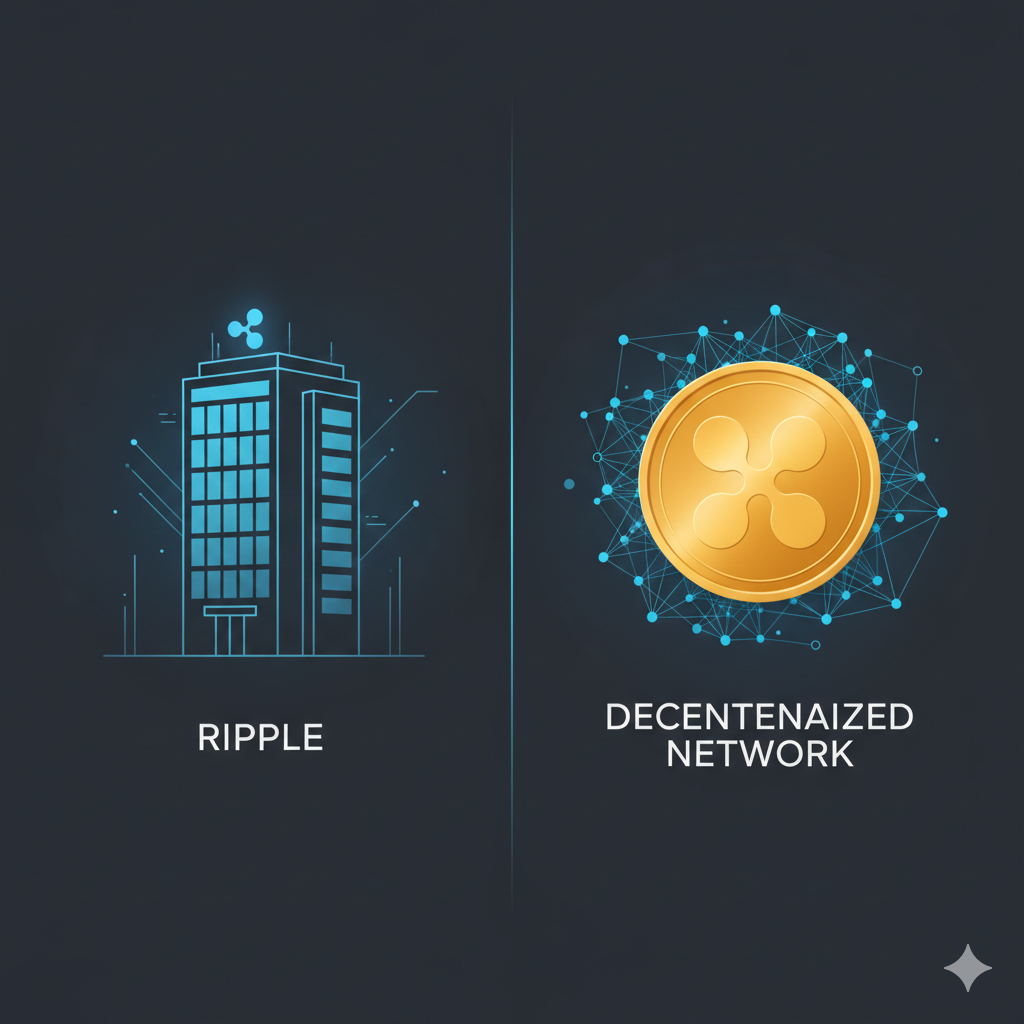
The confusion between Ripple and XRP is one of the most persistent misconceptions in crypto. Journalists write 'Ripple coin,' investors say they 'bought Ripple,' and even some exchange listings have used the terms interchangeably. In reality, Ripple and XRP are related but fundamentally distinct  and understanding the difference has real implications for how you should evaluate XRP as an investment and understand its technology.
What Is Ripple (the Company)?
Ripple is a San Francisco-based fintech company, officially Ripple Labs Inc., founded in 2012. It has raised over .3 billion in venture capital and employs hundreds of people globally. Ripple builds payment infrastructure for financial institutions: RippleNet (messaging and settlement network), On-Demand Liquidity (ODL, which uses XRP as a bridge currency), and Ripple Custody (institutional digital asset custody).
Ripple does hold a large amount of XRP  approximately 45–50 billion XRP kept in a series of escrow accounts, releasing up to 1 billion per month on a transparent schedule. This is Ripple's treasury, used for partnerships, ODL market-making, institutional sales, and company operations.
Critically: Ripple does NOT control the XRP Ledger. The XRPL is maintained by an independent, global community of validators. Ripple operates some validators, but so do universities, banks, and independent operators worldwide.
- ✓Founded 2012, HQ: San Francisco, USA
- ✓Raised .3B+ in venture capital funding
- ✓Products: RippleNet, ODL, Ripple Custody, Ripple Payments
- ✓Holds ~45B XRP in transparent monthly escrow
- ✓Does NOT control or own the XRP Ledger
- ✓Separate legal entity from the XRP asset itself
What Is XRP (the Digital Asset)?
XRP is the native digital asset of the XRP Ledger (XRPL), an open-source, public blockchain created in 2012. It was built by three independent developers: Jed McCaleb, Arthur Britto, and David Schwartz. They created 100 billion XRP at genesis and gifted 80 billion to OpenCoin (now Ripple Labs) to fund development, retaining 20 billion among themselves.
The XRP Ledger is entirely independent of Ripple the company. It has its own validator network (150+ validators globally), its own developer community, and its own governance structure. Ripple could cease operations entirely and the XRP Ledger would continue functioning  validators would keep running, transactions would keep processing.
XRP settles transactions in 3–5 seconds for a fraction of a cent. It has no mining (all 100B XRP were created at genesis), uses a unique consensus mechanism (Federated Byzantine Agreement), and has been operating continuously since 2012 with no successful attacks on its consensus layer.
- ✓Native asset of the open-source XRP Ledger
- ✓Created by McCaleb, Britto, Schwartz  not Ripple
- ✓100 billion XRP created at genesis, no mining ever
- ✓Settles in 3–5 seconds for under .001
- ✓XRPL has 150+ independent validators globally
- ✓Operates independently of Ripple company decisions
Key Differences: Side-by-Side Comparison
Ripple is a private company with shareholders, a board of directors, employees, and profit motives. XRP is a public digital asset with no owner, no CEO, and no ability to be shut down. This distinction matters enormously for regulatory treatment, investment risk profile, and long-term survival.
When you buy XRP on an exchange, you are not buying equity in Ripple Labs. You own no claim on Ripple's revenue, IP, or assets. Ripple's business success can positively influence XRP adoption and demand, but the two are legally and economically separate.
The SEC lawsuit against Ripple (2020–2023) highlighted this distinction. The court ruled that XRP sold on secondary markets (exchanges) was not a security  meaning buying XRP from an exchange is legally different from participating in Ripple's institutional sales. This was a landmark clarification for the entire industry.
- ✓Ripple: private company | XRP: public digital asset
- ✓Ripple can be sued, regulated, or shut down | XRPL cannot
- ✓Buying XRP ? investing in Ripple stock
- ✓SEC ruled secondary market XRP is not a security (2023)
- ✓XRP's code is open source and forkable by anyone
- ✓Ripple's escrow releases are transparent and predictable
Why the Confusion Exists  and Why It Matters
The confusion stems largely from early branding and media coverage. Ripple built its business identity around XRP, marketed XRP as the fuel for its payment products, and was one of the largest XRP holders. This created a natural  but incorrect  perception that they are the same thing.
The distinction matters for investors for three reasons: (1) XRP's value is driven by network utility and market dynamics, not Ripple's corporate performance. (2) Regulatory actions against Ripple (the company) don't necessarily invalidate XRP as an asset. (3) XRP's survival is not contingent on Ripple's survival  the ledger is self-sustaining.
For practical purposes, Ripple's success in growing ODL adoption and XRPL ecosystem does benefit XRP demand. But investors should understand they are betting on the asset's utility and adoption  not on Ripple's corporate success as a company.
Ripple vs XRP Frequently Asked Questions
Earn XRP Daily  No Corporate Risk
XRP's value is driven by its utility as a bridge currency and payment asset  independent of any single company. Build your XRP position with MineXrpOnline's cloud mining, earning daily returns from .
Start Earning XRP