Tokenomics — the economics of a cryptocurrency's supply, distribution, and incentives — is one of the most important factors in evaluating any digital asset. XRP's tokenomics are unique: 100 billion tokens were created at inception with no mining and no inflation, but the supply dynamics are shaped by a sophisticated escrow system and a gradual burn mechanism that make XRP's long-term supply characteristics distinct from any other major cryptocurrency.
XRP Supply: The Full Breakdown
XRP Supply: The Full Breakdown
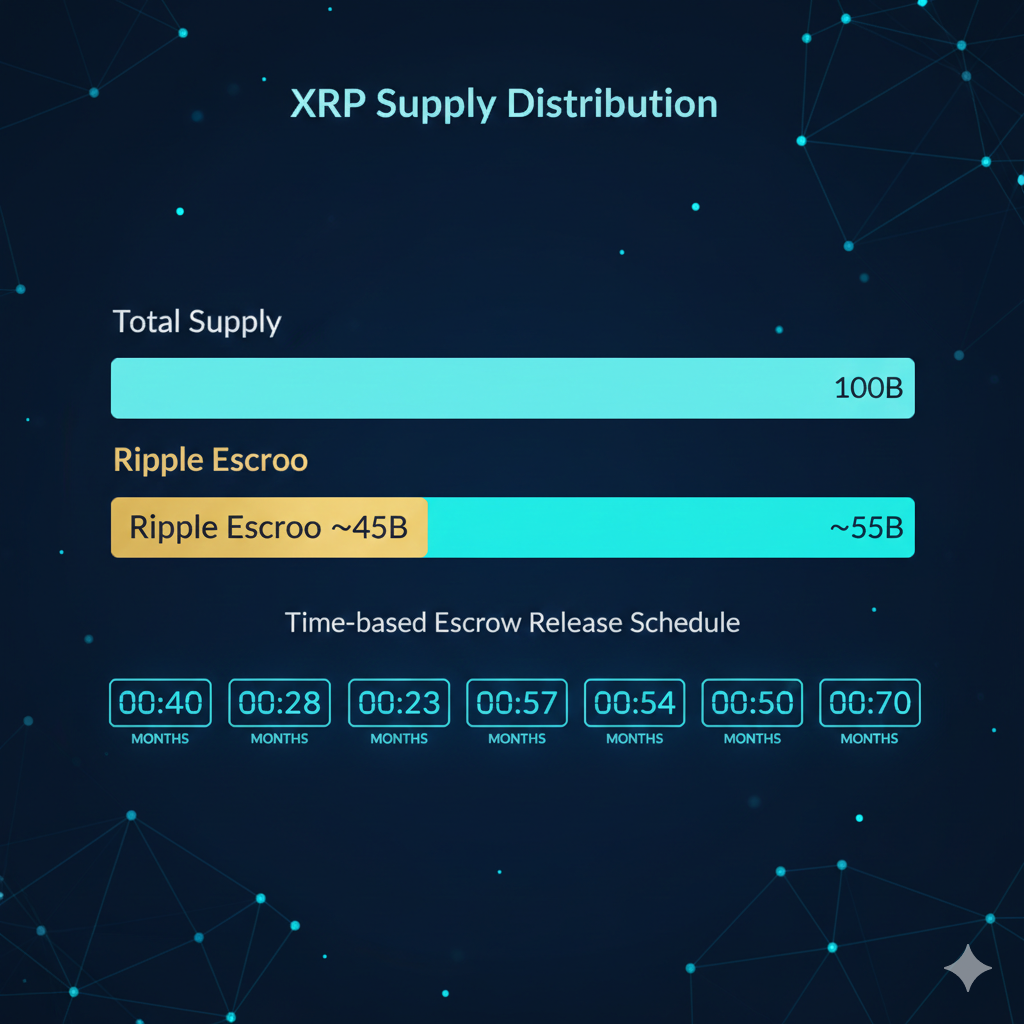
Unlike Bitcoin which introduces new supply via mining (currently ~900 BTC/day), XRP has zero inflation. The 100B supply was created at block zero in 2012. However, a small amount is destroyed (burned) with every transaction, making XRP mildly deflationary over time. With billions of transactions occurring annually on the XRPL, the burn rate is gradually but permanently reducing total supply.
Bitcoin's total supply cap of 21 million is often cited as a key value driver through scarcity. XRP's 100 billion supply sounds large by comparison, but the comparison is misleading. XRP's utility is as a bridge currency for institutional payments — a use case that benefits from higher supply and lower per-unit price for practical payment denomination. The $150 trillion annual cross-border payment market requires a bridge asset with sufficient supply depth.
- ✓Total supply: 100 billion XRP (fixed, no more can ever be created)
- ✓Circulating supply (approx): ~55 billion XRP currently in market
- ✓Ripple escrow holdings: ~45 billion XRP locked in monthly escrow
- ✓Monthly escrow release: up to 1 billion XRP (any unused portion is re-locked)
- ✓Transaction burn: 0.00001 XRP destroyed per transaction, permanently
- ✓No mining rewards: zero new XRP is ever created — fixed deflationary supply
Understanding Ripple's Escrow System
Understanding Ripple's Escrow System
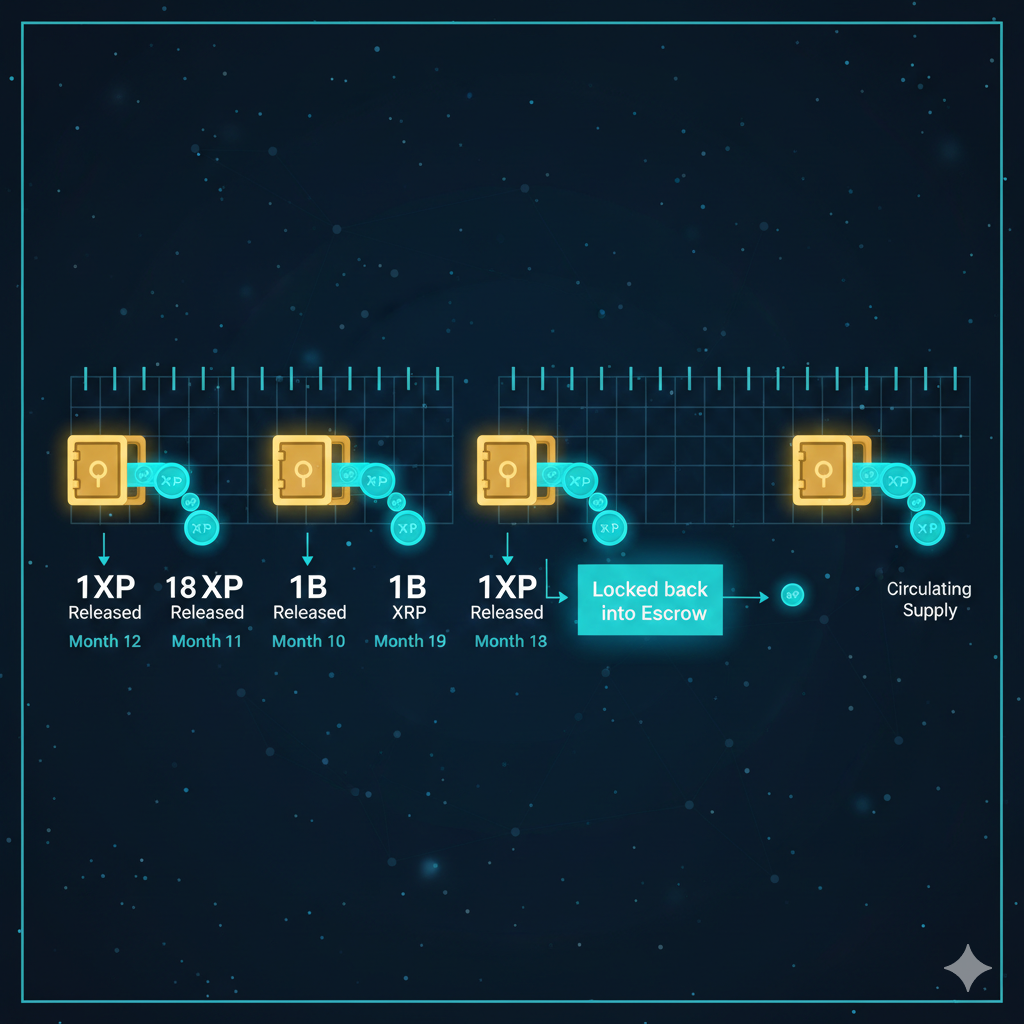
In 2017, Ripple locked approximately 55 billion XRP into a series of 55 escrow accounts — one releasing per month. At the end of each month, up to 1 billion XRP is released. Any unused portion is immediately re-locked into new escrow accounts at the back of the queue, currently extending the escrow schedule by many years beyond the original 55-month period.
This system was implemented to provide transparency and predictability around Ripple's XRP sales, addressing community concerns about the potential for Ripple to flood the market with XRP at any time. The escrow mechanism is enforced at the blockchain level — not by Ripple's word — meaning it cannot be unilaterally changed or bypassed.
In practice, Ripple typically sells well under the full 1 billion monthly release. Most of the released XRP that isn't sold directly is returned to escrow immediately. Ripple discloses all XRP sales in quarterly XRP Markets Reports, providing institutional-grade transparency about supply dynamics that most crypto projects do not offer.
XRP vs Bitcoin vs Ethereum: Supply Model Comparison
XRP vs Bitcoin vs Ethereum: Supply Model Comparison
Bitcoin has a hard cap of 21 million — there will never be more. New supply is introduced through mining block rewards, currently 3.125 BTC per block (post-April 2024 halving). Supply issuance decreases by half every ~4 years until approximately 2140 when all 21 million are mined. This programmatic scarcity is Bitcoin's core value proposition as 'digital gold.'
Ethereum has no hard cap but uses a burn mechanism (EIP-1559, active since August 2021) that destroys base transaction fees. During periods of high network usage, the burn rate exceeds the staking issuance rate, making ETH net deflationary. During low-usage periods, ETH is mildly inflationary. The total ETH supply fluctuates between approximately 120–122 million depending on network activity.
XRP's supply model is distinct from both: 100% pre-mined at genesis, no new issuance ever, but a transparent escrow release schedule that introduces a predictable, bounded amount of supply each month. The Ripple escrow mechanism separates XRP from pure 'hard cap' assets like Bitcoin but provides the predictability that institutional investors require to model supply dynamics.
The XRP Burn Mechanism: Long-Term Deflationary Dynamics
The XRP Burn Mechanism: Long-Term Deflationary Dynamics
Every XRP transaction permanently destroys 0.00001 XRP (10 drops). This prevents spam attacks by making it costly to flood the network with transactions while being negligibly cheap for legitimate users. The XRPL processes approximately 1–2 million transactions per day in normal conditions, burning roughly 10–20 XRP daily — approximately 3,650–7,300 XRP annually.
At this burn rate, the deflationary impact on the 55 billion circulating supply is extremely gradual — at 7,000 XRP/year burned, it would take over a million years to reduce supply by 1%. However, as XRPL adoption increases (particularly if ODL volumes grow to process trillions in annual payment flows), transaction counts and burn rates could increase by orders of magnitude.
Future XRPL features could accelerate burns significantly. AMM pools (live since February 2024) add new transaction types. Hooks (forthcoming programmable transaction logic) would enable smart contract interactions on XRPL, each burning XRP. CBDC pilot programs could add millions of transactions. The burn mechanism ensures that increased utility directly translates to reduced supply — a positive feedback loop for long-term token economics.
Who Actually Holds XRP? Distribution Analysis
Who Actually Holds XRP? Distribution Analysis
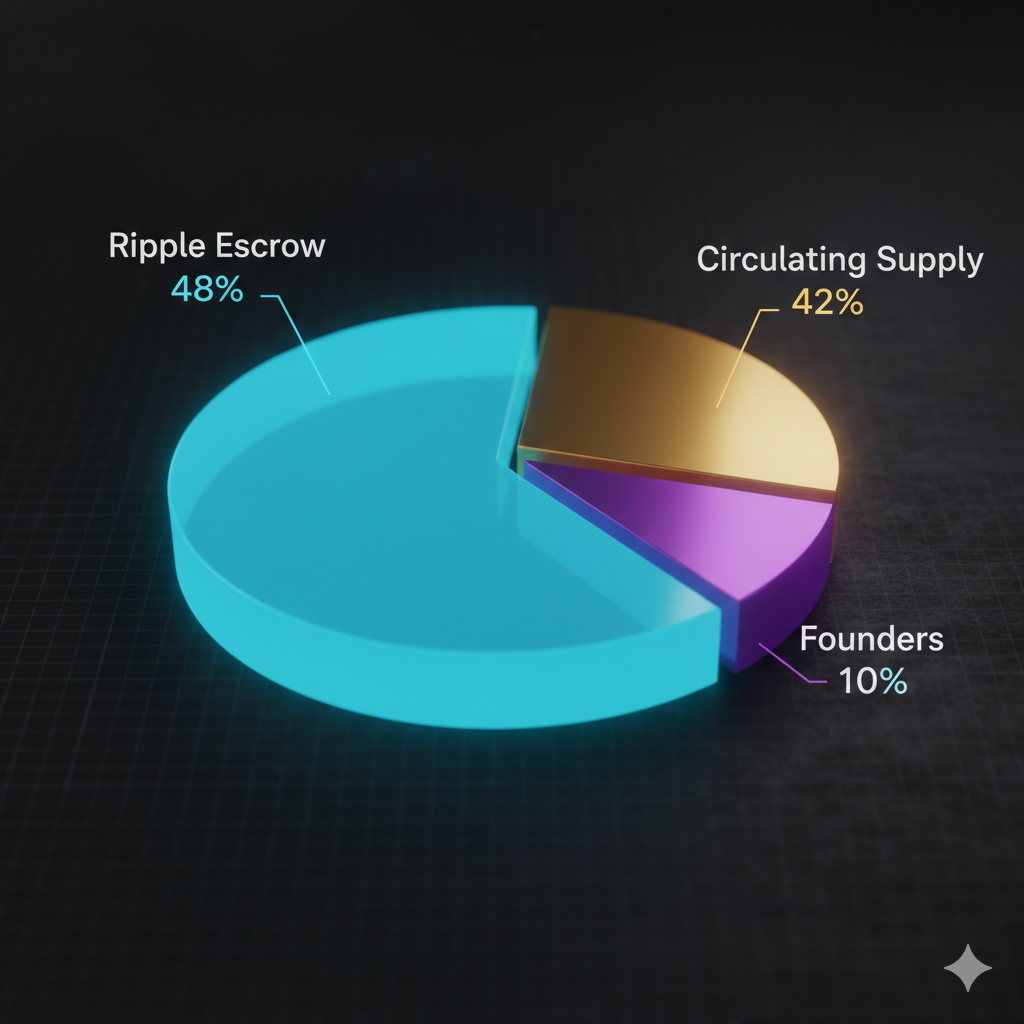
XRP ownership concentration is a common point of critique. Beyond Ripple's ~45 billion in escrow, on-chain analysis shows that large exchange wallets (Binance, Coinbase, Bitstamp) hold billions of XRP on behalf of customers. The actual retail distribution across individual wallets is broader than the raw largest-wallet analysis suggests.
The Ripple founding team (Jed McCaleb, Arthur Britto, and David Schwartz) originally retained approximately 20 billion XRP. Jed McCaleb's holdings became a known market overhang for years — he sold XRP steadily through a settlement agreement with Ripple. McCaleb's XRP was fully sold by 2023 based on on-chain analysis, removing this supply overhang from the market.
For long-term investors, the key supply consideration is Ripple's escrow transparency: every monthly release is announced, every quarterly sale is reported, and the entire escrow schedule is visible on-chain. This provides far more supply clarity than most cryptocurrencies, where large holders can dump at any time with zero advance notice.
XRP Tokenomics FAQs
Accumulate XRP With Daily Mining Returns
With a fixed supply and growing utility, XRP's long-term fundamentals are strong. MineXrpOnline lets you accumulate XRP daily through cloud mining — no waiting for price dips required.
Start Accumulating XRP