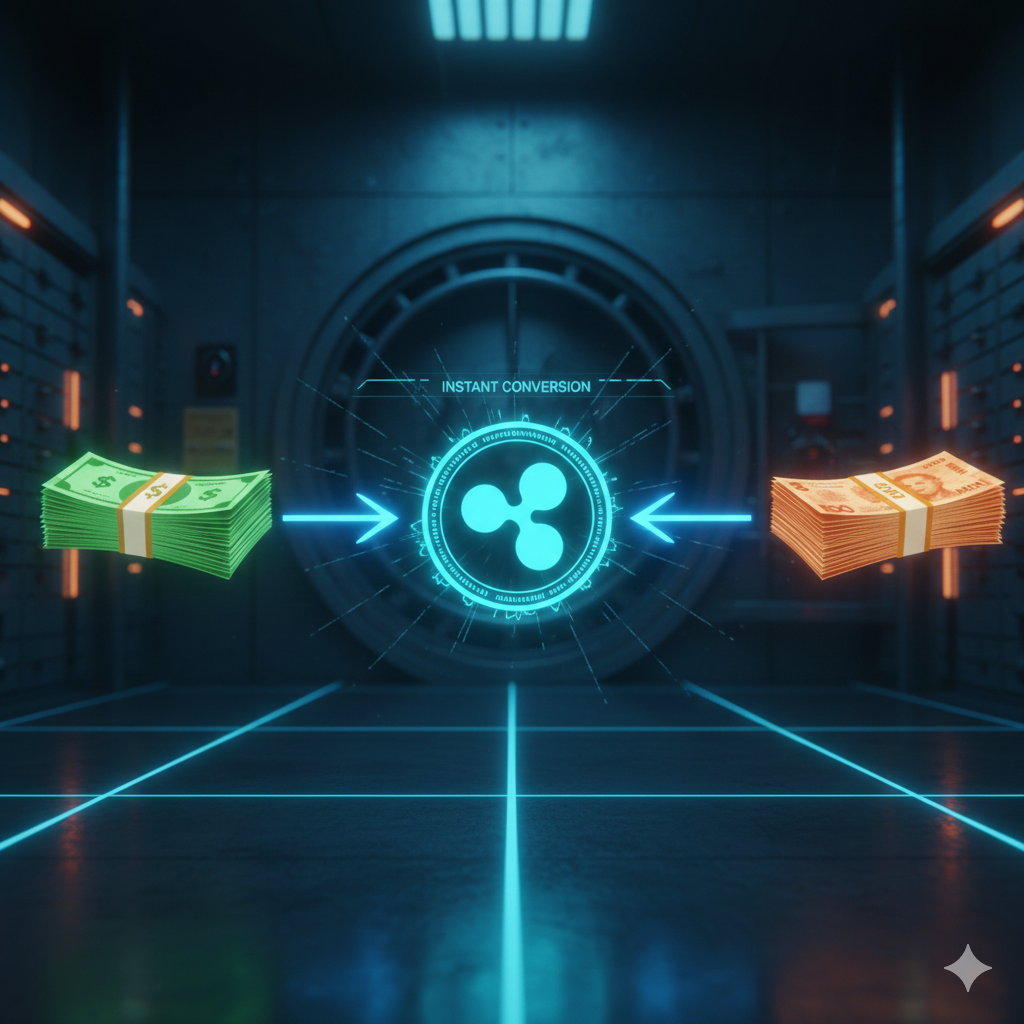
Traditional cross-border payments require financial institutions to pre-fund accounts in every currency market they operate in  capital that sits idle, earns nothing, and ties up over $10 trillion globally. Ripple's On-Demand Liquidity (ODL) eliminates this entirely by using XRP as a real-time bridge asset. The entire flow  converting source currency to XRP, transmitting across the XRP Ledger, and converting to destination currency  completes in under 5 seconds. No pre-funded nostro accounts. No correspondent bank chains. No multi-day settlement delays.
The Pre-Funding Problem ODL Solves
When a US bank needs to send money to the Philippines on demand, it must maintain a pre-funded PHP account at a Filipino correspondent bank. That capital sits idle, earns no yield, and serves only as a reserve buffer. Multiply this across every currency corridor globally and you have the $10+ trillion idle capital problem that burdens the entire international banking system.
ODL flips this model entirely. Instead of pre-funding, the sending institution converts USD to XRP at the moment of the transaction, XRP moves across the XRPL in 3–5 seconds with guaranteed finality, and the receiving institution immediately converts XRP to local currency. Total pre-funded capital required: zero.
This is not theoretical. ODL is processing real institutional payment flows in production across dozens of corridors. Payment processors serving 40+ countries have integrated ODL, and Ripple reports growing transaction volumes in every consecutive quarter since 2022.
- ✓$10+ trillion locked in idle pre-funded correspondent accounts globally
- ✓ODL eliminates 100% of pre-funding requirement for active corridors
- ✓Settlement under 5 seconds vs 1–5 business days for SWIFT wires
- ✓Cost per transaction under $1 vs $25–$50 average international wire fee
- ✓No currency exposure during transit  XRP held for only 3–5 seconds
- ✓40+ countries served by ODL-integrated payment processors in 2026
How ODL Works: Step-by-Step
Step 1  Source conversion: The sending payment processor converts USD (or source currency) to XRP on a crypto exchange in the sending country. This happens programmatically via API in milliseconds at live market rates.
Step 2  XRPL transmission: XRP is sent across the XRP Ledger to a destination wallet. Ledger settlement takes 3–5 seconds with immediate finality  unlike Bitcoin's 10-minute blocks or Ethereum's variable confirmation times.
Step 3  Destination conversion: On the destination side, XRP is immediately converted to local currency (PHP, MXN, AUD, EUR) on a local exchange. The recipient receives local currency in their account within seconds of initiation.
Market makers at both ends of the corridor provide the XRP liquidity depth that makes this work at scale. Ripple's Liquidity Hub and RippleNet Connected clients provide additional depth for high-volume corridors.
- ✓Exchange A: source currency ? XRP (milliseconds)
- ✓XRPL transmission: 3–5 seconds, finality guaranteed
- ✓Exchange B: XRP ? local currency (milliseconds)
- ✓Total end-to-end: under 30 seconds for full settlement
- ✓No correspondent bank relationship required
- ✓Automated via Ripple Payments API  no manual intervention
Active ODL Corridors and Volume Growth
ODL launched commercially in 2019 starting with the USD-MXN corridor (Mexico is the largest recipient of US remittances). It has since expanded to USD-PHP, USD-AUD, EUR-MXN, and multiple Asian corridors including partnerships with SBI Holdings in Japan and Tranglo across Southeast Asia.
Volume has grown dramatically year over year. Ripple's quarterly XRP Markets Reports detail ODL growth, consistently showing double-digit percentage increases in transaction count and value. The Asia-Pacific region is the fastest-growing ODL market, driven by massive overseas worker remittance flows.
Africa and the Middle East represent the next frontier. Countries like Nigeria, Ghana, and Egypt have significant cross-border payment volumes that are currently expensive and slow  exactly the problem ODL solves.
- ✓USD-MXN: flagship corridor, highest volume
- ✓USD-PHP: major corridor for Filipino overseas workers
- ✓EUR-MXN, USD-AUD, USD-BRL: established corridors
- ✓Asia-Pacific: SBI Holdings Japan, Tranglo Southeast Asia
- ✓Africa/Middle East: emerging high-growth corridors
- ✓10x+ volume growth reported from 2022 to 2026
ODL vs SWIFT: Real-World Cost Comparison
SWIFT processes 40+ million messages daily but adds 1–5 business days of settlement delay, requires correspondent bank chains (each taking fees), and offers no real-time FX price discovery. A typical international wire costs $25–$50 in bank fees plus a 1–3% FX markup hidden in the exchange rate.
ODL eliminates correspondent bank chains, settles in seconds, and executes at live exchange rates with sub-$1 XRP network fees. For high-frequency payment processors, the cost difference is transformational  saving millions annually in pre-funding costs alone.
A payment processor handling $1 billion in annual cross-border flows might need to pre-fund $50–$100 million in nostro accounts under SWIFT. Under ODL, that capital can be deployed productively elsewhere, representing a massive working capital improvement.
XRP ODL Frequently Asked Questions
Earn XRP While Banks Use It
Every ODL transaction drives organic XRP demand. As Ripple's payment network expands to more corridors and countries, XRP utility strengthens. Build your XRP position with MineXrpOnline's cloud mining  daily returns starting from $15.
Start Earning XRP Daily