Web1 (1990s) was the read-only internet: static pages, no interaction. Web2 (2000s–present) is the read-write internet: social media, user-generated content, centralized platforms that monetize your data. Web3 is the proposed read-write-own internet: users control their data, identities, and digital assets through blockchain-based systems. This isn't just a technical upgrade — it's a fundamental shift in who benefits from internet activity.
The Problem Web3 Is Solving
The Problem Web3 Is Solving
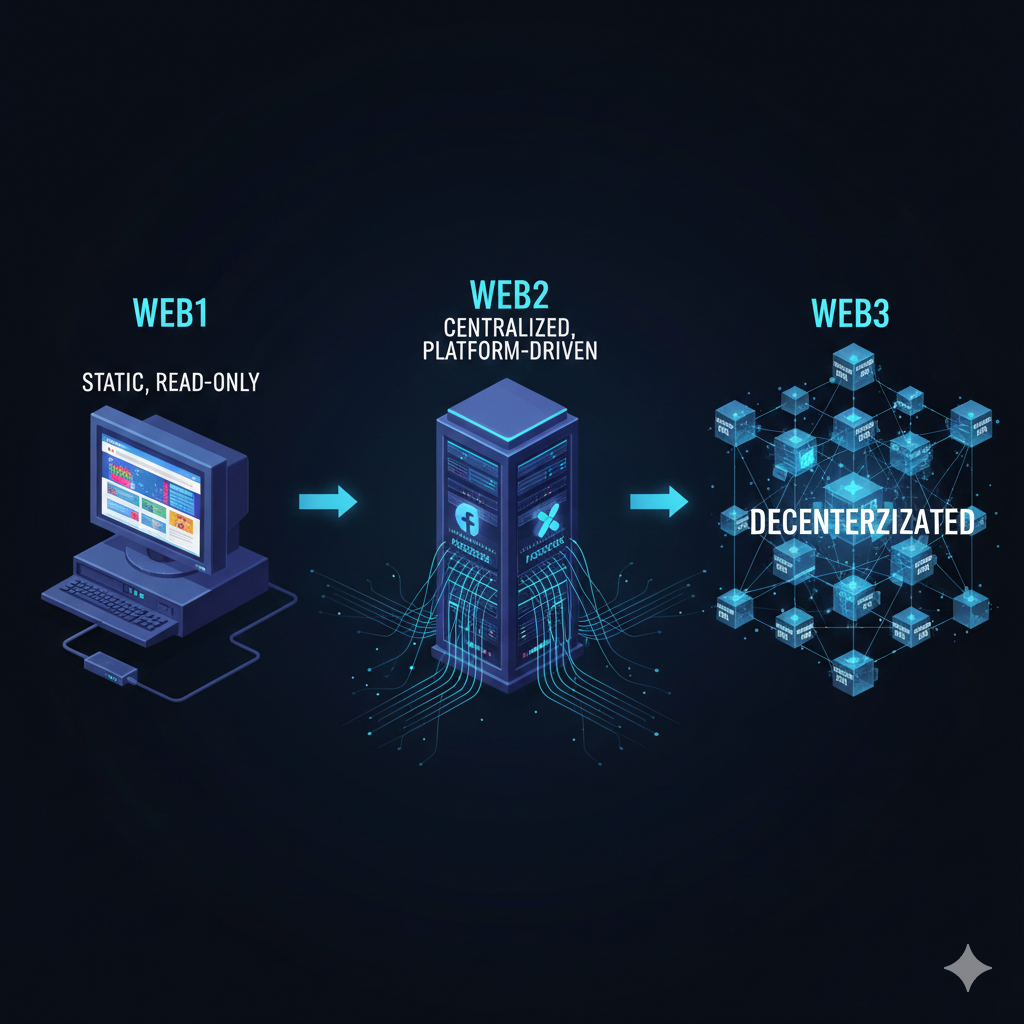
In Web2, platform companies own all the data, set all the rules, and capture all the economic value generated by users. Twitter can ban your account (removing years of content and followers). App stores can remove your game (taking your virtual items). Facebook can sell your data without meaningful compensation to you.
Web3 uses blockchain technology to create user ownership: you own your tokens, NFTs, domain names, and social graph in wallets you control. Platforms cannot arbitrarily revoke access because the data exists on-chain, not on corporate servers. The key insight is portability — if a Web3 social platform shuts down, your social graph, posts, and followers can theoretically move to another platform running the same protocol.
The scale of the Web2 data economy makes Web3's alternative compelling. Google earns $200+ billion annually primarily from advertising on user behavior data. Facebook earns $130+ billion. Almost none of that value flows back to the users generating the content and data. Web3 proposes a different model where protocol users receive native tokens and fee shares proportional to their contribution to network activity.
The Web3 Technology Stack
The Web3 Technology Stack

Understanding the Web3 stack helps clarify why different blockchains serve different purposes. Ethereum is the dominant smart contract platform — most DeFi protocols, NFT marketplaces, and DAOs run on Ethereum or its Layer 2 networks. Solana optimizes for high speed and low cost (popular for gaming, NFTs, and consumer apps). The XRP Ledger specializes in payments and asset settlement — the financial infrastructure layer of Web3.
Wallets are the login mechanism for Web3. Instead of a username/password stored on a company's server, your wallet is a cryptographic key pair you control. Your wallet address is your identity across all Web3 applications — you bring it with you to every dApp, and all your history and assets are visible and portable.
- ✓Layer 1 blockchains: Ethereum, Solana, XRP Ledger — provide base security and settlement
- ✓Smart contracts: on-chain logic for DeFi, DAOs, NFT ownership, lending protocols
- ✓Wallets: MetaMask, Phantom, Xumm — your identity and asset manager in Web3
- ✓ENS / XRPL username services: human-readable Web3 domain names (.eth, .xrp)
- ✓Decentralized storage: IPFS, Arweave — data storage not controlled by corporations
- ✓DAOs: decentralized governance of protocols and communities
- ✓Oracles: Chainlink, Pyth — bridge between on-chain and real-world data
Real Web3 Applications Being Used Today
Real Web3 Applications Being Used Today
Uniswap is perhaps the most successful Web3 application: a decentralized exchange processing $1+ billion in daily trading volume with no company in the middle, no KYC requirements, and trading fees going directly to liquidity providers — not a corporate treasury. Over $2 trillion in total volume has been processed since launch.
ENS (Ethereum Name Service) assigns human-readable .eth domain names to wallet addresses — transforming 0x742d...4F3b into 'alice.eth'. This is the Web3 equivalent of DNS, and over 3 million .eth names have been registered. The XRP Ledger has native username functionality through XRPL domains, enabling simple wallet addresses like $name.
Lens Protocol represents Web3 social: a decentralized social graph where your followers, posts, and content are NFTs in your wallet. Any application can read from the Lens protocol — if your current front-end platform shuts down, you don't lose your social graph. Farcaster, another decentralized social protocol, has attracted a highly engaged developer community and is growing rapidly.
Web3 and Digital Ownership: NFTs and Tokenization
Web3 and Digital Ownership: NFTs and Tokenization
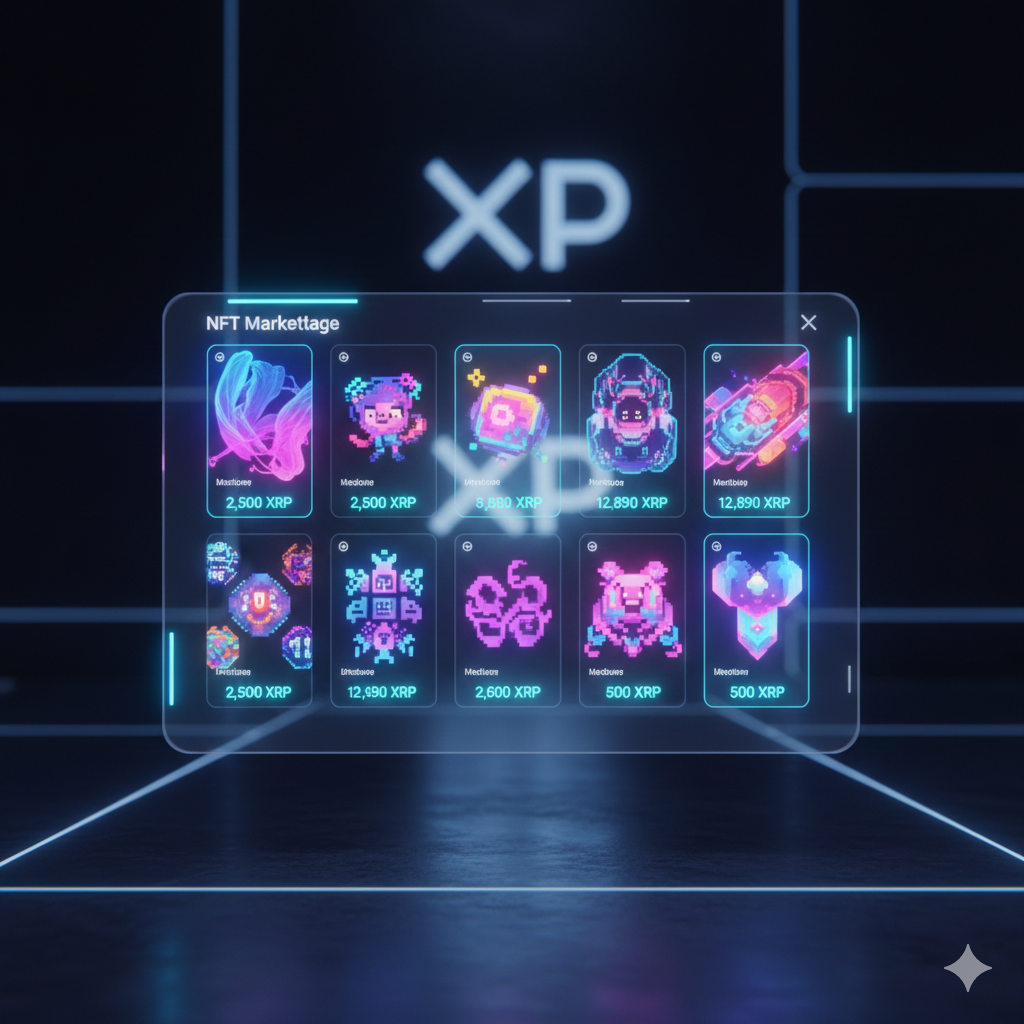
Non-Fungible Tokens (NFTs) are blockchain-based proof of ownership for unique digital items. While the 2021 NFT speculation bubble featured absurd prices for profile pictures, the underlying technology has lasting applications: digital art with programmable royalties, gaming items that outlive individual games, tickets with anti-scalping mechanisms, and real-world asset tokenization.
Real-world asset (RWA) tokenization is one of the most promising Web3 developments for 2026 and beyond. Tokenizing real estate, bonds, treasury bills, and private equity on blockchains like XRPL enables fractional ownership, 24/7 trading, and global accessibility to asset classes previously restricted to wealthy investors. Blackrock's tokenized money market fund (BUIDL) on Ethereum reached $500M+ in AUM, signaling mainstream institutional adoption.
The XRP Ledger's native DEX and low transaction costs make it particularly suited for tokenized asset trading — institutions can settle tokenized securities in 3–5 seconds for fractions of a cent, compared to T+2 settlement in traditional markets. Several fintech companies are building RWA tokenization products on XRPL specifically for this reason.
Web3 Challenges: What Still Needs to Be Solved
Web3 Challenges: What Still Needs to Be Solved
Web3's biggest barrier remains user experience. Managing seed phrases, paying gas fees, and understanding wallet interactions creates a massive friction barrier compared to simply logging in with Google. Research from ConsenSys shows that wallet UX problems cause 80%+ of Web3 app abandonment. Account abstraction — a new Ethereum standard allowing wallets without seed phrases, gasless transactions, and session keys — is the most promising near-term solution.
Regulatory clarity is the other major obstacle, particularly in the US. The SEC's aggressive stance toward crypto between 2022–2024 created significant legal uncertainty for Web3 builders. The regulatory environment has improved substantially with spot Bitcoin and ETH ETF approvals and Congressional crypto legislation advancing, but full clarity is still developing. The EU's MiCA framework (effective 2024) provides a clear regulatory path for European Web3 companies.
Security remains a significant challenge: over $3 billion was lost to DeFi exploits in 2023 alone. Smart contract bugs, bridge vulnerabilities, and social engineering attacks regularly cause significant losses. Formal verification of smart contracts, improved auditing standards, and insurance protocols (Nexus Mutual, InsurAce) are helping, but security incidents remain far too common.
Web3 FAQs
Participate in the Web3 Economy Today
The best way to start in Web3 is to own crypto assets. Build your XRP position by cloud mining with MineXrpOnline — your gateway into the Web3 economy.
Enter Web3 with XRP