Blockchain technology solved a problem that cryptographers and computer scientists had wrestled with for decades: how do you get a group of untrusting strangers to agree on a shared truth without a central authority? The solution, introduced in Bitcoin's 2008 whitepaper, has spawned an industry worth trillions.
The Core Architecture: Blocks and Chains
The Core Architecture: Blocks and Chains
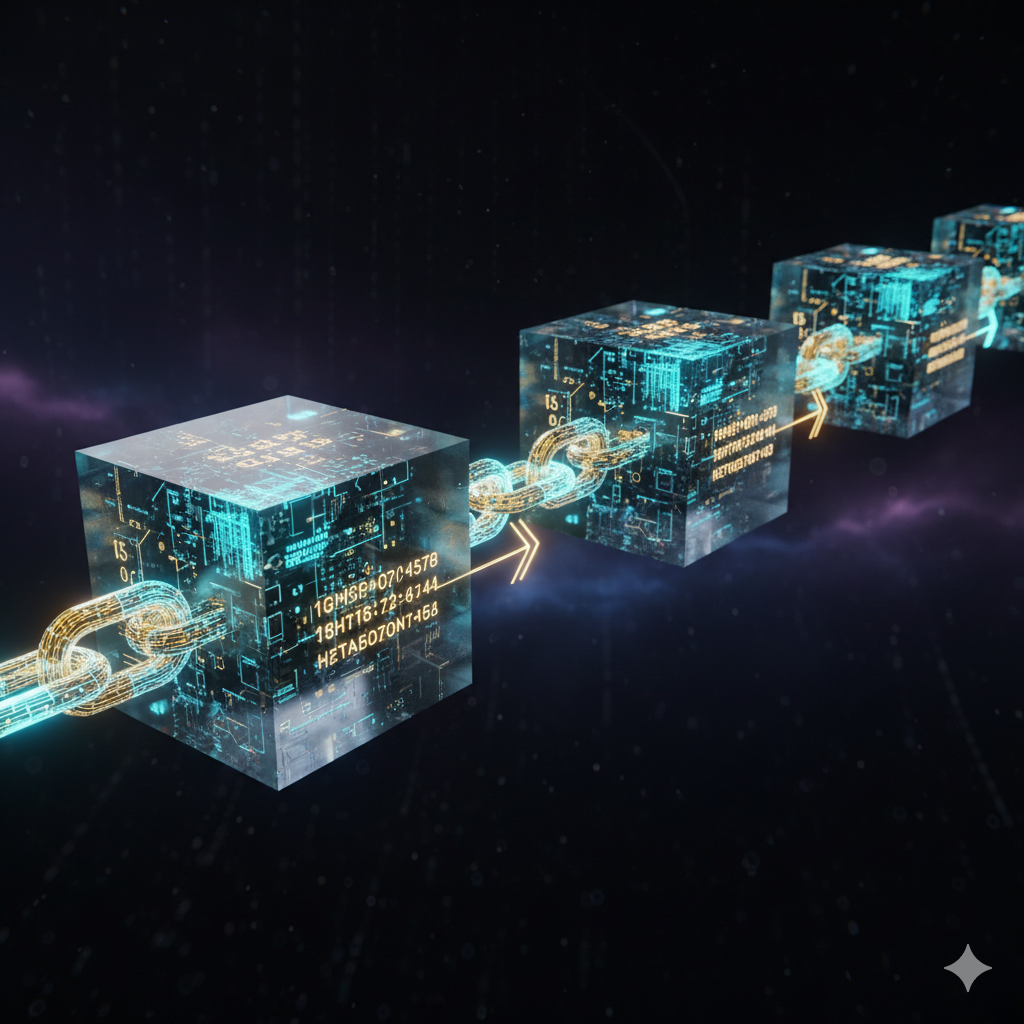
Blocks: Data Containers
Each block contains: a batch of validated transactions, a timestamp, a reference to the previous block (hash), and a nonce (proof of solution for PoW chains). The transactions are arranged in a Merkle tree, allowing efficient verification of individual transactions without downloading the entire block.
The Hash Link: Immutability Explained
Each block contains the cryptographic hash of the PREVIOUS block in its header. Changing any transaction in a past block changes that block's hash, which then invalidates every subsequent block's reference. This 'chain of custody' makes retroactive alteration computationally prohibitive in large, secured networks.
The Distributed Ledger
Unlike a traditional database hosted on one server, the blockchain is replicated simultaneously across thousands of nodes worldwide. To attack the network, an adversary would need to simultaneously compromise the majority (51%) of all nodes — practically impossible for major blockchains.
Blockchain Types: Public vs Private vs Consortium
Blockchain Types: Public vs Private vs Consortium

- ✓Public blockchains: Bitcoin, Ethereum, XRP Ledger — anyone can read, write, validate
- ✓Private blockchains: company-controlled, faster, but not truly decentralized
- ✓Consortium blockchains: trusted set of companies share control (R3 Corda, Quorum)
- ✓Permissioned vs permissionless: who can validate transactions
- ✓XRP Ledger: technically public but uses trusted validator lists (UNL)
Blockchain Technology FAQs
The XRP Ledger: Production-Grade Blockchain Since 2012
XRP runs on one of the most efficient, battle-tested blockchains in existence. Start accumulating XRP through cloud mining on MineXrpOnline.
Mine on XRP Ledger