Imagine a company where every decision — from hiring to treasury allocations to product direction — is made by token-holder vote, with outcomes automatically executed by smart contracts. No politics, no back-room deals, no executives ignoring shareholders. This is the DAO model, and it is functioning at scale with billions of dollars under governance. Understanding DAOs is understanding the future of organizational structure in a digital economy.
How DAOs Work: Governance Mechanics
How DAOs Work: Governance Mechanics
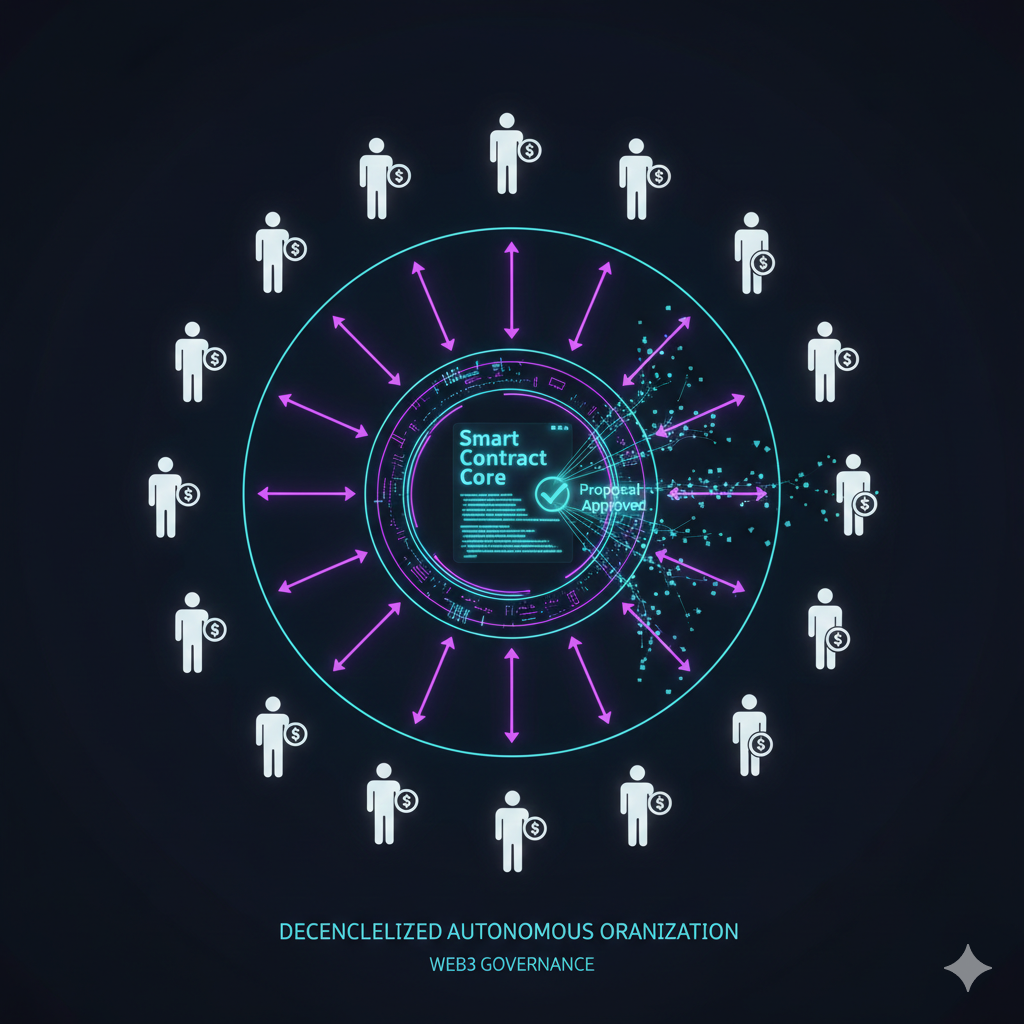
Members hold governance tokens (COMP for Compound, UNI for Uniswap, MKR for MakerDAO, AAVE for Aave) that grant voting rights proportional to holdings. Proposals are submitted, discussed in community forums (Discourse, Discord), then voted on-chain. If the required quorum votes 'yes,' the smart contract automatically executes the decision.
This creates genuine accountability: the code cannot be lobbied, bribed, or pressured. Governance token holders have direct financial incentive to vote for decisions that benefit the protocol — their tokens lose value if the protocol fails. This alignment between governance rights and economic stake is a fundamental innovation over traditional corporate governance.
The proposal lifecycle typically spans two weeks: 3–5 days of community discussion (off-chain), 3–7 days of on-chain voting, then immediate smart contract execution. Time-locks (a delay between vote approval and execution) are a security feature — they give the community time to exit if a malicious proposal somehow passes.
Notable DAOs and Their Impact
Notable DAOs and Their Impact
MakerDAO is the most financially significant DAO in existence. It governs the DAI stablecoin — a decentralized dollar backed by crypto collateral — and manages risk parameters for $8+ billion in collateral. MKR holders vote on stability fees, debt ceilings, and which assets can serve as collateral. Their decisions directly impact the global DeFi market since DAI is used throughout the ecosystem.
ConstitutionDAO demonstrated DAOs' unique ability to coordinate capital at unprecedented speed. Within 72 hours, over 17,000 contributors pooled $47 million to bid at Sotheby's for an original US Constitution copy. Though they lost the bid by a narrow margin, the experiment proved that decentralized coordination could compete with major institutional buyers at the highest levels of traditional finance.
- ✓MakerDAO: manages the DAI stablecoin, $8B+ protocol treasury, sets stability fees
- ✓Uniswap DAO: governs the world's largest DEX, controls $1B+ community treasury
- ✓ConstitutionDAO: crowd-funded $47M in 72 hours to bid for the US Constitution (2021)
- ✓Nouns DAO: sells one NFT per day, 100% of proceeds to community-controlled treasury
- ✓Gitcoin: funds open-source public goods via quadratic voting mechanisms
- ✓Arbitrum DAO: governs the largest Ethereum L2, with 3.5B ARB tokens in circulation
- ✓ENS DAO: governs the Ethereum Name Service (.eth domain system)
DAO Treasury Management: Where the Real Power Is
DAO Treasury Management: Where the Real Power Is

The most powerful aspect of DAOs may not be governance votes but treasury control. Major DeFi DAOs have accumulated hundreds of millions to billions of dollars in treasury assets. Uniswap DAO controls approximately $3 billion in UNI tokens. Compound's treasury holds $500M+. These funds are deployed based on community vote for development grants, partnerships, liquidity incentives, and protocol security.
Treasury management has evolved significantly. Early DAOs held almost 100% of their treasury in their own governance token — extremely risky since a token price crash could wipe out the treasury when they needed it most. Modern DAO best practices include diversifying into stablecoins (USDC, DAI) and blue-chip crypto (ETH, BTC) to maintain a war chest that holds value regardless of governance token performance.
Grant programs funded by DAO treasuries have become a primary driver of blockchain ecosystem development. Uniswap Grants, Compound Grants, and Gitcoin Grants have collectively distributed hundreds of millions of dollars to open-source developers, researchers, and community projects — funded entirely by community vote without any corporate entity making the decisions.
DAO Weaknesses and Ongoing Challenges
DAO Weaknesses and Ongoing Challenges
DAOs face three structural challenges that traditional companies do not. First, voter apathy: typically only 5–15% of token holders vote on any given proposal. Most holders are passive investors, not active governors. This concentrates real governance power among a small set of highly engaged participants and large holders who vote consistently.
Second, plutocracy risk: governance weight proportional to token holdings means wealthy holders (whales, VCs, founding teams) can dominate outcomes. A single holder with 20% of governance tokens can often block or pass proposals unilaterally. Several DAOs have experimented with quadratic voting (where voting power scales with the square root of holdings) to reduce whale dominance, but implementation challenges limit adoption.
Third, governance attacks: the 2023 Beanstalk hack was a spectacular example — an attacker used a flash loan to borrow enough governance tokens to pass a malicious proposal in a single transaction, stealing $182 million. Time-locks, multi-sig execution, and snapshot voting for off-chain signal gathering are the main defenses, but governance security remains an active research area.
The Future: Sub-DAOs, Delegated Governance, and Legal Wrappers
The Future: Sub-DAOs, Delegated Governance, and Legal Wrappers
Mature DAOs are evolving beyond simple token voting. Sub-DAOs delegate specific responsibilities to specialized working groups: a security council for emergency decisions, a grants committee for ecosystem funding, a risk team for parameter management. This prevents governance paralysis while maintaining decentralized oversight of the overall system.
Delegation has become a critical feature in modern DAO design. Holders who don't have time to evaluate every technical proposal can delegate their voting power to trusted representatives (similar to elected officials) who vote on their behalf. Compound and Uniswap both support delegation, and specialized governance delegates have emerged as a new profession in the ecosystem.
Legal recognition is advancing rapidly. Wyoming's 2021 DAO LLC law was pioneering, and the Marshall Islands, Switzerland, and Cayman Islands have followed with DAO-friendly frameworks. Legal wrapping allows DAOs to sign contracts, employ people, and engage with the traditional legal system while maintaining decentralized governance — solving the 'DAO as legal person' problem.
DAO FAQs
Participate in the Decentralized Economy
Start by accumulating XRP — a core digital asset in the decentralized financial ecosystem. MineXrpOnline's cloud mining builds your position every day.
Start Accumulating