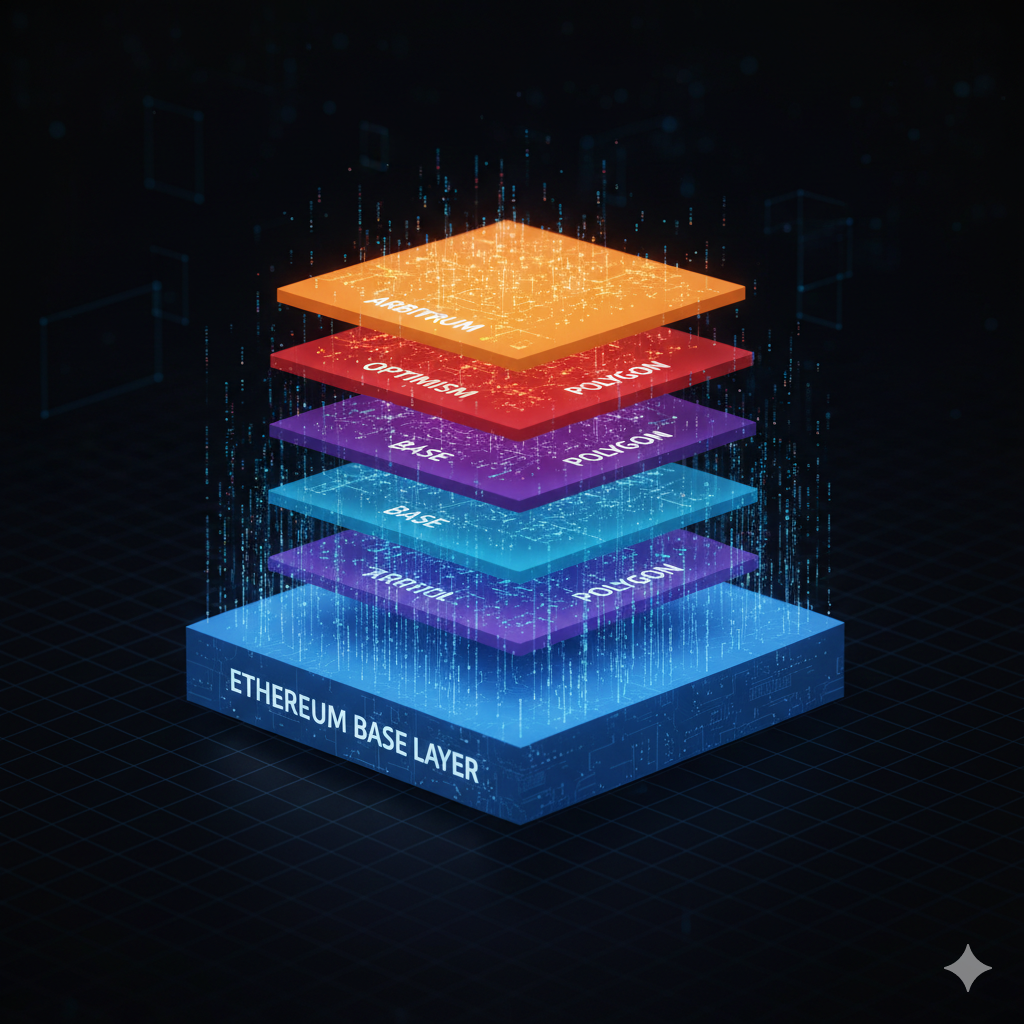
Ethereum's greatest strength — security and decentralization — is also its greatest limitation: slow throughput and expensive gas fees. Arbitrum solves this through Optimistic Rollup technology, processing thousands of transactions off-chain and settling them in batches on Ethereum. The result: full Ethereum security at a fraction of the cost. In 2026, Arbitrum hosts hundreds of DeFi protocols, NFT marketplaces, and gaming applications, making it the most important Layer 2 network in the ecosystem.
How Arbitrum Works: Optimistic Rollups Explained
Arbitrum uses a technology called Optimistic Rollups: transactions are processed on the Arbitrum network and 'optimistically' assumed to be valid without immediately proving each one on Ethereum. A fraud-proof window (typically 7 days) allows anyone to challenge invalid transactions, providing the security guarantee.
This architecture means Arbitrum inherits Ethereum's security model while executing transactions 10–40x faster and at 10–100x lower cost. The tradeoff: withdrawing funds from Arbitrum back to Ethereum mainnet requires waiting through the 7-day challenge period (unless using a fast bridge).
Arbitrum operates two networks: Arbitrum One (the main DeFi network with maximum security) and Arbitrum Nova (optimized for gaming and social applications with a data availability committee for lower costs). Most DeFi activity happens on Arbitrum One.
- ✓Optimistic Rollups: transactions assumed valid, challenged if fraudulent
- ✓7-day fraud proof window for withdrawals to Ethereum mainnet
- ✓Fast bridges (Stargate, Across, Hop) bypass the 7-day wait for a small fee
- ✓Arbitrum One: main DeFi network, Ethereum-equivalent security
- ✓Arbitrum Nova: gaming/social chain with Data Availability Committee
- ✓EVM equivalent: any Ethereum smart contract deploys unchanged on Arbitrum
How to Bridge ETH to Arbitrum
The official Arbitrum bridge (bridge.arbitrum.io) allows you to transfer ETH and ERC-20 tokens from Ethereum mainnet to Arbitrum One. Deposits are quick (10–15 minutes), while withdrawals back to mainnet take 7 days without using a third-party fast bridge.
For faster bridging in both directions, protocols like Stargate Finance, Across Protocol, and Hop Exchange provide near-instant cross-chain transfers for a small fee (typically 0.05–0.1% of the transfer amount). These protocols use liquidity pools to instantly fulfill withdrawals rather than waiting for the fraud-proof window.
You'll need ETH on Arbitrum to pay gas fees, even when transacting with other tokens. Gas on Arbitrum is paid in ETH but is typically less than $0.05 per transaction — compared to $1–$50+ on Ethereum mainnet depending on congestion.
- ✓Official bridge: bridge.arbitrum.io — deposits in 10–15 min, withdrawals 7 days
- ✓Fast bridges: Stargate, Across, Hop — near-instant at 0.05–0.1% fee
- ✓Always bridge some ETH first before bridging other tokens (need ETH for gas)
- ✓Add Arbitrum One to MetaMask: Chain ID 42161, RPC https://arb1.arbitrum.io/rpc
- ✓Minimum bridge amount: no minimum, but small amounts may not be worth the gas
- ✓Never bridge to an exchange deposit address — only personal wallets
Top DeFi Protocols on Arbitrum
Arbitrum hosts the richest DeFi ecosystem outside of Ethereum mainnet. GMX, the perpetual futures DEX, pioneered the 'real yield' narrative on Arbitrum — distributing 70% of trading fees directly to token stakers and liquidity providers in ETH rather than inflationary tokens. This model attracted billions in TVL.
Uniswap V3 deployed on Arbitrum, giving traders access to the most liquid DEX in crypto at a fraction of Ethereum mainnet costs. Camelot DEX is Arbitrum-native and focuses on new project launches with innovative tokenomics. Pendle Finance, which tokenizes future yield, also has major liquidity on Arbitrum.
For lending, Aave V3 on Arbitrum provides efficient capital utilization with cross-chain collateral options. Radiant Capital pioneered omnichain lending on Arbitrum. The combination of trading, lending, and yield protocols makes Arbitrum a complete DeFi ecosystem.
- ✓GMX: perpetual futures with real ETH yield for liquidity providers
- ✓Uniswap V3: most liquid DEX on Arbitrum, low-cost swaps
- ✓Camelot DEX: Arbitrum-native AMM with innovative ve(3,3) tokenomics
- ✓Aave V3: lending with E-mode for correlated asset pairs
- ✓Pendle Finance: yield tokenization and fixed-rate DeFi
- ✓Total Arbitrum DeFi TVL: $15–25 billion in 2026
The ARB Token: Governance & Staking
ARB is the governance token for Arbitrum DAO, which controls the future direction of the Arbitrum protocol. ARB holders vote on protocol upgrades, fee parameters, and treasury spending. The token was airdropped to early Arbitrum users in March 2023 in one of the largest airdrops in crypto history.
The Arbitrum DAO controls a treasury of over 3.5 billion ARB tokens (~35% of total supply), one of the largest DAO treasuries in crypto. Regular governance proposals allocate these funds to ecosystem grants, builder programs, and protocol improvements.
While ARB itself doesn't yet have a staking mechanism with yield, various DeFi protocols on Arbitrum use ARB in liquidity mining programs. Providing liquidity on Camelot or other native protocols often rewards users with ARB tokens in addition to trading fees.
- ✓ARB total supply: 10 billion tokens
- ✓DAO treasury: 3.5B ARB for ecosystem development
- ✓Governance: vote on protocol upgrades through Arbitrum DAO portal
- ✓Early user airdrop: 625M ARB distributed in March 2023
- ✓ARB used in liquidity mining incentives across Arbitrum DeFi
- ✓No native staking yield for ARB token as of 2026 (governance only)
Frequently Asked Questions About Arbitrum
Explore Ethereum Layer 2 & Earn XRP
While you explore DeFi on Arbitrum, also consider XRP cloud mining as a simple, hands-off passive income strategy. MineXrpOnline generates daily XRP rewards without the complexity of managing DeFi positions. Start earning today.
Try XRP Cloud Mining