
In traditional finance, index funds consistently outperform 85%+ of actively managed funds over 15-year periods. The principle — low-cost diversification across a market — applies equally well to crypto portfolios. Crypto index funds deliver exposure to the entire market's growth without the selection risk of individual altcoin bets. As institutional products have matured since 2023, the choices available to both retail and institutional investors have expanded significantly.
How Crypto Index Funds Work
How Crypto Index Funds Work
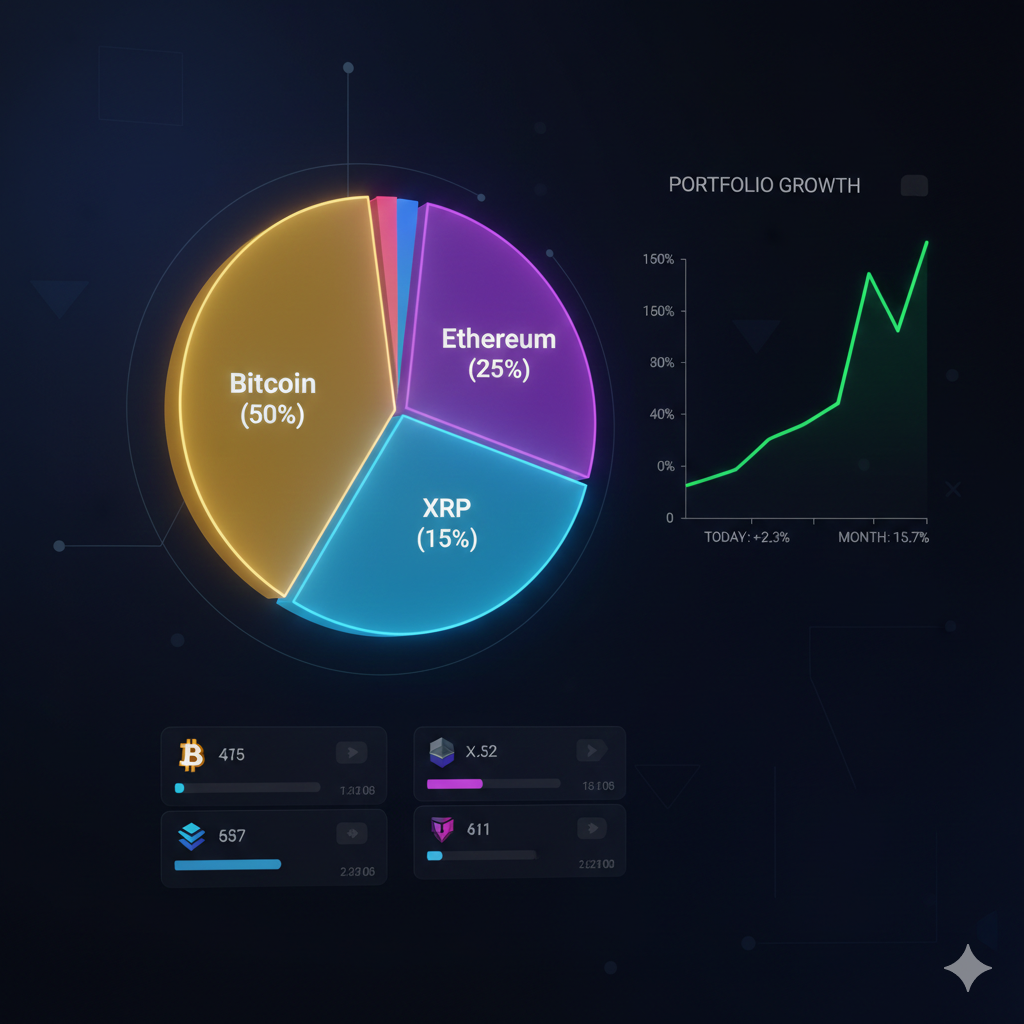
Most crypto index funds use market capitalization weighting — larger market cap coins receive larger portfolio allocation, automatically. When Bitcoin's dominance rises, the index automatically reduces altcoin exposure; when altcoins surge, the index captures that growth proportionally. The top 10 cryptocurrencies by market cap typically represent 75–85% of the total market, so a top-10 index captures the vast majority of market movements.
The major advantage: automatic rebalancing. When Bitcoin surges 50% while altcoins stagnate, the index fund sells proportional Bitcoin and buys underweighted altcoins — systematically selling high and buying low without any active decision-making. This disciplined rebalancing is psychologically difficult for individual investors to execute but happens automatically in an index structure.
Some crypto index products use equal-weighting (each coin gets the same allocation regardless of market cap) or theme-based weighting (e.g., DeFi index weights by protocol revenue). Equal-weight indices tend to outperform in altcoin bull markets but underperform in Bitcoin-dominance phases. Understanding the weighting methodology before investing is important because it fundamentally changes the risk/return profile.
Leading Crypto Index Products in 2026
Leading Crypto Index Products in 2026

Bitwise Asset Management has become the dominant player in regulated US crypto index products. Their Bitwise 10 Crypto Index Fund is SEC-registered and has AUM exceeding $1 billion, making it accessible through traditional brokerage accounts for the first time in crypto history. The index rebalances monthly and includes BTC, ETH, XRP, SOL, ADA and other major assets.
For European investors, 21Shares and ETC Group offer crypto ETP products listed on major stock exchanges including Deutsche Börse and SIX Swiss Exchange. These physically-backed products hold the underlying crypto assets and can be purchased through any standard European brokerage — no crypto exchange account required.
- ✓Bitwise 10 Crypto Index Fund: top 10 market cap weighted, fully regulated, SEC-registered
- ✓Grayscale Digital Large Cap Fund: BTC, ETH, XRP, SOL, ADA exposure via traditional brokerage
- ✓21Shares Crypto Basket 10 ETP: European market, stock exchange listed, UCITS-compliant
- ✓Nasdaq Crypto Index (NCI): institutional benchmark, basis for futures products
- ✓Galaxy Crypto Index: institutional allocation product for accredited investors
- ✓DeFi Pulse Index (DPI): on-chain index of top DeFi protocol tokens via Index Coop
- ✓Crypto20 (C20): tokenized index fund tradeable directly on DEXs and CEXs
On-Chain Index Tokens: A New Option
On-Chain Index Tokens: A New Option

Index Coop has pioneered on-chain index tokens: smart contract-managed baskets of crypto assets that can be bought as a single token on DEXs or CEXs. The DeFi Pulse Index (DPI) holds the top DeFi governance tokens. The Data Economy Index (DATA) focuses on oracle and data tokens. These tokens are transparent, non-custodial, and redeemable for the underlying assets at any time.
On-chain index tokens eliminate custodial risk — your exposure is held in the smart contract, not with an institution. The trade-off is smart contract risk and lower liquidity compared to institutional products. For DeFi-native investors who are already comfortable with on-chain interactions, these products offer the most transparent and flexible index exposure available.
Index Fund vs. Individual Holdings: Making the Choice
Index Fund vs. Individual Holdings: Making the Choice
A common professional strategy is the 'core-satellite' approach: allocate 60–70% of the crypto portfolio to a broad index fund (the 'core') and 30–40% to high-conviction individual positions (the 'satellite'). This provides market exposure with low maintenance while allowing meaningful positions in assets with the strongest individual thesis — like XRP, with its institutional payment utility.
Pure index investing makes the most sense for investors who don't have time to research individual projects, want diversification across market cycles, and want to avoid the emotional decision-making that comes with single-asset volatility. For active researchers with specific insights, combining a core index with 2–4 high-conviction positions tends to produce the best risk-adjusted returns.
Historical data from TradFi shows a consistent pattern: the average retail investor underperforms the market index by 1–3% annually due to poor timing, overtrading, and emotional decisions. Crypto investors with no research edge are likely to experience the same underperformance vs. a passive index strategy — making the case for at least partial index allocation compelling.
Tax Efficiency and Rebalancing Considerations
Tax Efficiency and Rebalancing Considerations
One underappreciated advantage of index fund structures: tax efficiency. When you hold an ETF or index product, the fund manager handles rebalancing internally — you don't trigger a taxable event each time the index rebalances. If you hold individual coins and manually rebalance your portfolio, each sale is a taxable event that must be reported.
In many jurisdictions, crypto ETPs and index fund shares are treated as securities for tax purposes, with potentially favorable long-term capital gains treatment if held over 1 year. Check with a tax professional for your specific jurisdiction, as crypto tax rules vary significantly across countries and are evolving rapidly.
Crypto Index FAQs
Add Focused XRP Accumulation to Your Index Strategy
While index funds provide broad exposure, MineXrpOnline lets you overweight XRP specifically — the asset with the most compelling utility case. Earn XRP daily while your index fund handles diversification.
Earn XRP Daily