Ethereum processes 15 transactions per second. Visa handles 24,000+. Bridging this gap without sacrificing decentralization or security is the central technical challenge of blockchain development. The solutions being built today will determine the scalability ceiling of Web3 — and several of them are already live and processing millions of transactions daily.
The Blockchain Trilemma Explained
The Blockchain Trilemma Explained
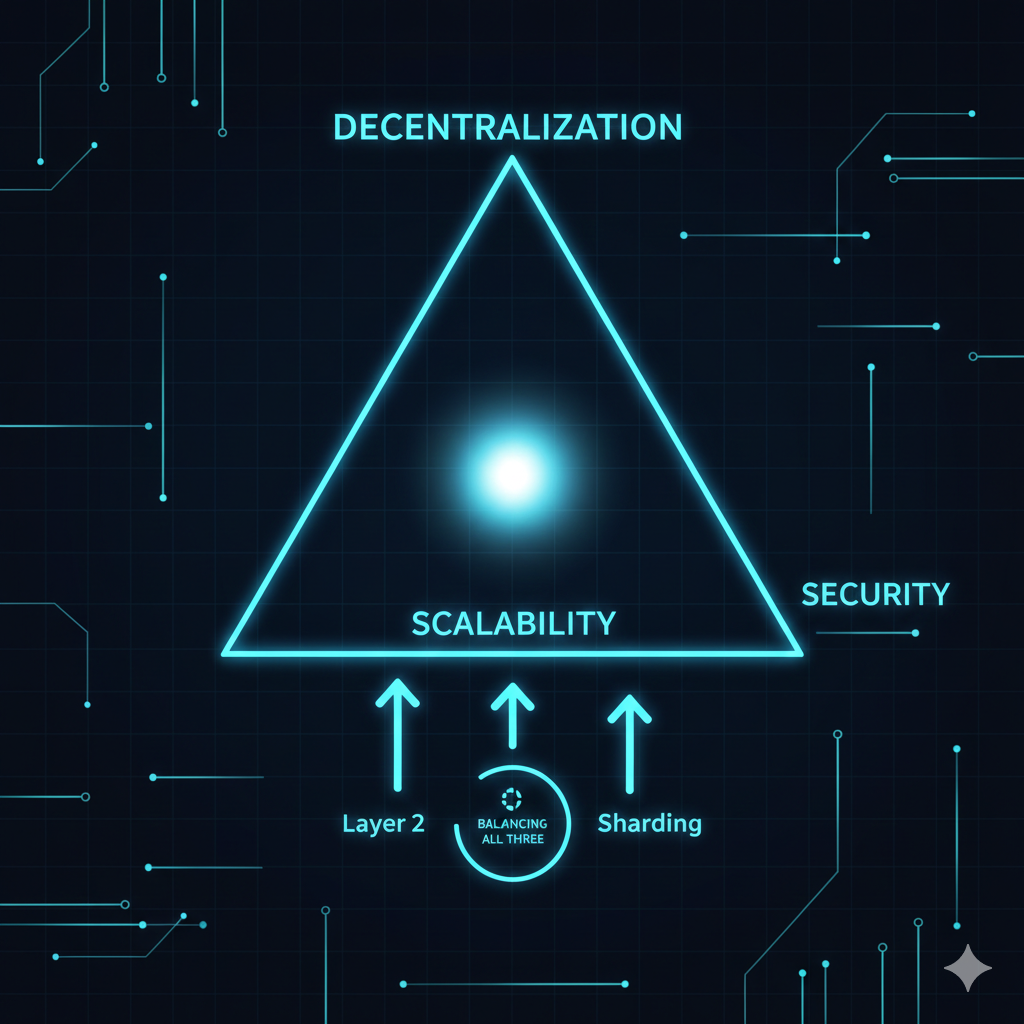
The blockchain trilemma (coined by Vitalik Buterin) states that blockchains can typically only optimize for two of three properties simultaneously: decentralization (many distributed validators), security (cost of attack), and scalability (transactions per second). This isn't a law of physics but a practical engineering constraint that describes most current blockchain designs.
Bitcoin chooses decentralization and security: anyone can run a node, the chain has never been successfully attacked, but 7 TPS is the throughput limit. Solana chose speed and partial decentralization: 65,000 TPS potential but higher validator requirements reduce node count. The XRP Ledger uses federated consensus to achieve payment-specific scalability without mining, reaching a practical equilibrium point for its specific use case.
Understanding these trade-offs explains why different blockchains serve different purposes — there is no single 'best' blockchain. Bitcoin's throughput limitation is a deliberate design choice to maintain maximum decentralization. Ethereum's approach of scaling at Layer 2 while maintaining Layer 1 decentralization represents a different philosophy for navigating the trilemma.
Solutions: From Layer 2 to Sharding
Solutions: From Layer 2 to Sharding
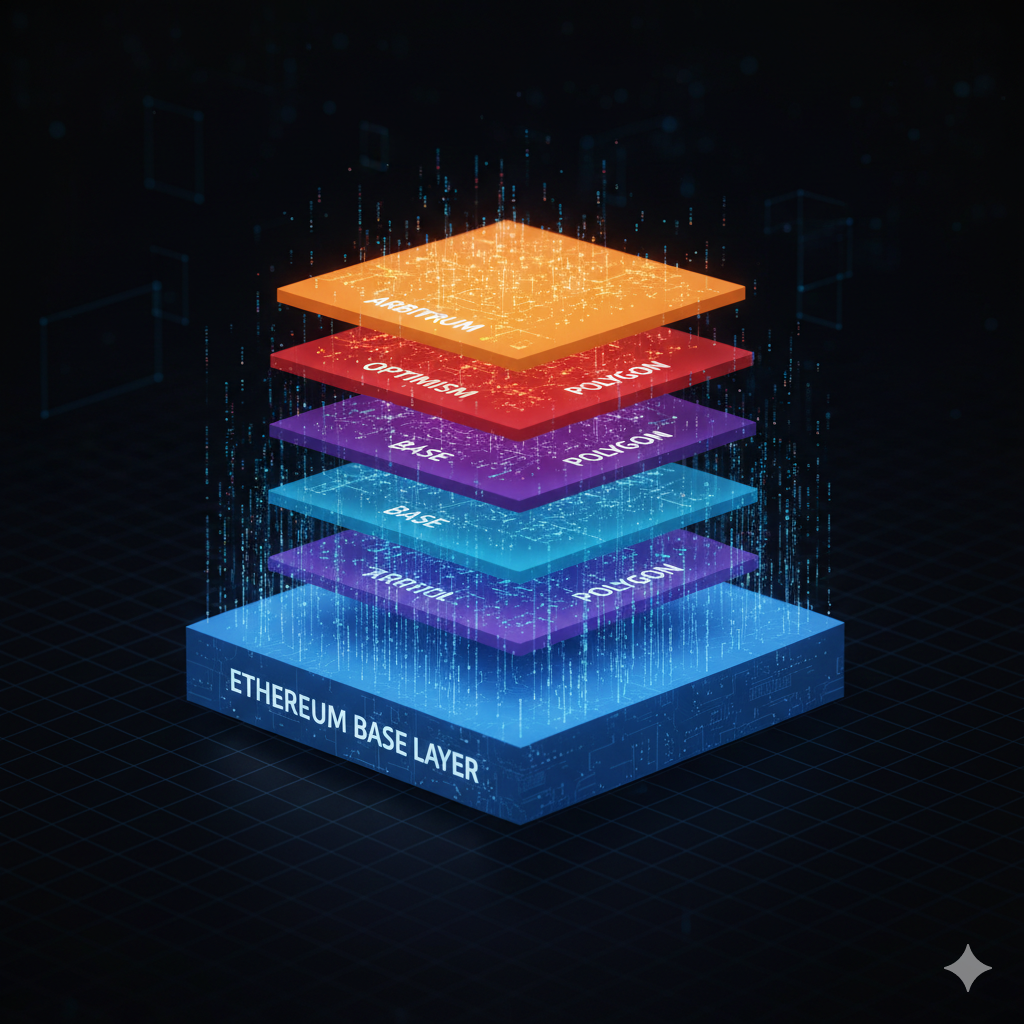
Layer 2 Rollups
Rollups execute transactions off-chain, then post compressed proofs or data to the mainchain. Optimistic Rollups (Arbitrum, Optimism, Base) assume validity and allow fraud proofs during a 7-day challenge window. ZK-Rollups (zkSync, StarkNet, Polygon zkEVM) use cryptographic validity proofs for instant finality. Both achieve 1,000–10,000 TPS while inheriting mainchain security. Arbitrum alone processes more transactions per day than Ethereum mainnet.
Sharding
Sharding splits the blockchain into parallel processing 'shards' — each handling a subset of transactions simultaneously. Ethereum's roadmap includes danksharding to massively increase data availability. EIP-4844 (blob transactions, deployed March 2024) is the first step, reducing L2 data costs by 10x. Full danksharding would push Ethereum's effective throughput to 100,000+ TPS across all L2 networks.
State Channels
State channels (Bitcoin's Lightning Network is the most prominent example) allow two parties to conduct unlimited off-chain transactions, only settling the final net balance on-chain. Lightning enables Bitcoin payments at 1 million+ TPS with near-zero fees. The trade-off: requires participants to lock capital in channels and maintain channel liquidity — less suitable for arbitrary smart contract interactions.
XRP Ledger's Native Scalability
XRPL's federated Byzantine Agreement consensus achieves 1,500+ TPS with 3–5 second finality natively at Layer 1 — no Layer 2 required for payments. This design decision was intentional: optimize payment-native performance for its specific use case as a settlement layer for financial institutions. XRPL also features a native DEX enabling atomic swaps at Layer 1 speeds.
Layer 2 Networks: The Current State
Layer 2 Networks: The Current State
As of 2026, Ethereum Layer 2 networks collectively process more transactions than Ethereum mainnet. Arbitrum leads by TVL ($15B+) and ecosystem depth. Base (Coinbase-backed, Optimism Stack) has seen explosive user growth by lowering the barrier to entry with near-zero fees and direct Coinbase integration. zkSync Era and Polygon zkEVM represent the next generation of ZK-proof-based rollups with superior security properties.
The average transaction fee on major L2 networks has dropped to $0.01–$0.05 following EIP-4844, making micro-transactions economically viable for the first time. This unlocks use cases that were previously impossible on Ethereum mainnet: micro-payments, high-frequency DeFi trading, and on-chain gaming with sub-cent transaction costs.
Cross-L2 interoperability remains a challenge. Users and applications often need assets on specific L2s, requiring bridging — which adds friction and security risk. Solutions like LayerZero and Chainlink CCIP enable cross-chain messaging and asset transfers, and the Superchain (OP Stack ecosystem) aims to create a seamlessly interoperable cluster of L2 networks.
Real-World Scalability Benchmarks in 2026
Real-World Scalability Benchmarks in 2026
Solana has demonstrated 65,000 TPS capability in testing, but network congestion during peak demand periods (major NFT mints, token launches) has repeatedly caused outages or degraded performance. Theoretical TPS and sustained production TPS are very different numbers — Solana typically sustains 2,000–4,000 TPS in normal conditions.
XRPL's 1,500 TPS sustained throughput is specifically designed for payment use cases and has been demonstrated in production with zero downtime since 2012. The theoretical limit is closer to 3,500 TPS with optimizations. For its target application (institutional payments, asset settlement), this throughput is more than sufficient for near-term global adoption — the world's total cross-border payment volume translates to roughly 100 TPS if fully settled on XRPL.
The Lightning Network (Bitcoin's Layer 2) theoretically enables millions of transactions per second through payment channels, but adoption has grown slowly due to complexity. As of 2026, Lightning has approximately 50,000 BTC in channel capacity and processes an estimated 1–5 million transactions monthly — meaningful but still a small fraction of Bitcoin's total transaction volume.
Scalability FAQs
Backed by the Most Efficient Payments Network
XRP's 1,500 TPS and $0.0001 fees make it ideal for real-world payments. Accumulate XRP now through MineXrpOnline cloud mining as global payment adoption expands.
Mine XRP Today