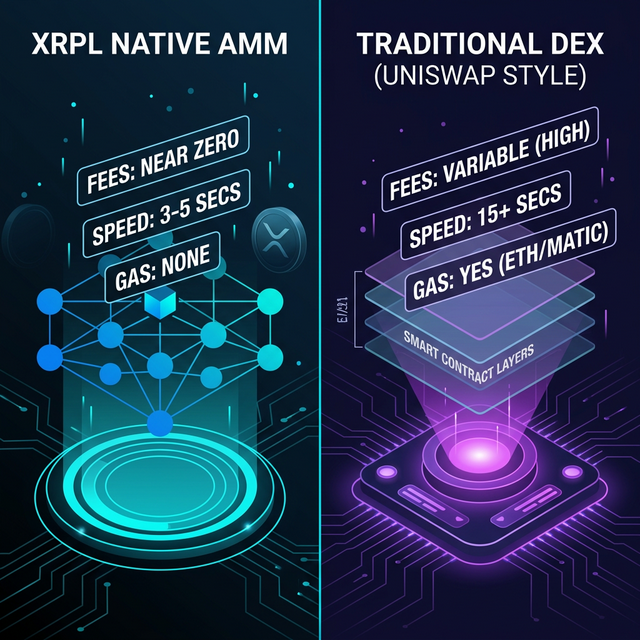
The XRP Ledger has had a native order book DEX since 2014 — long before Ethereum existed. But the native order book is only half the story. With AMM activation in February 2024, XRPL now offers both order book trading AND liquidity pool mechanics, creating a uniquely powerful DeFi primitive on the world's fastest settlement layer.
How XRPL's Native AMM Works
How XRPL's Native AMM Works
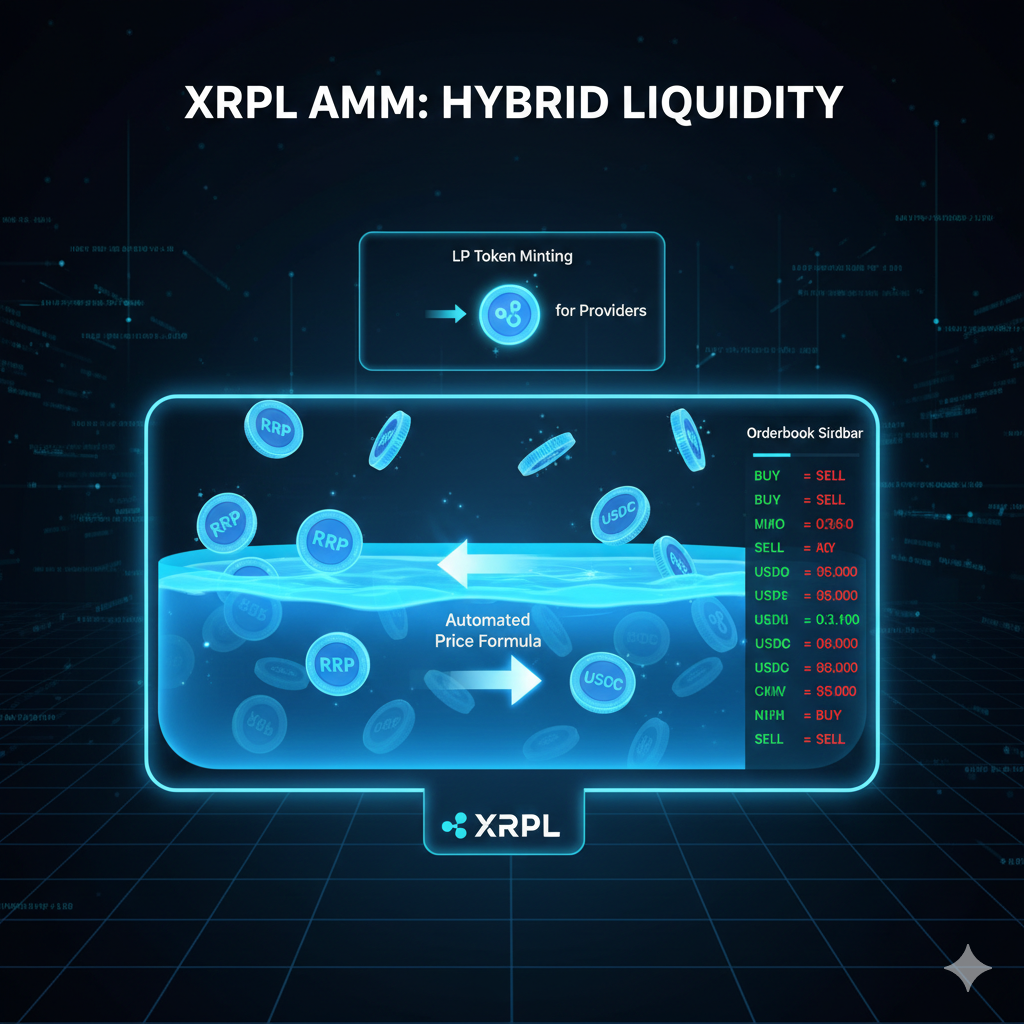
XRPL's AMM uses the constant product market maker formula (x * y = k), the same mathematics pioneered by Uniswap v2. However, XRPL's implementation has key architectural differences: the AMM is a first-class consensus object on the ledger, not a smart contract running on top of the ledger.
This means every AMM interaction (adding liquidity, trading, removing liquidity) goes through XRPL's consensus round — settling in 3-5 seconds with finality, without the smart contract execution overhead of EVM-based AMMs.
- ✓AMM activated via XRPL amendment: AMMCreate, AMMDeposit, AMMWithdraw transaction types
- ✓LP token standard: AMMCreate generates LP tokens representing pool shares
- ✓Trading fee: 0.3% default (configurable by pool governors up to 1%)
- ✓Continuous Auction Mechanism (CAM): XRPL's unique arbitrage incentive system
- ✓Integration with XRPL order book: price routing uses best price from either source
XRPL AMM vs Uniswap: Key Differences
XRPL AMM vs Uniswap: Key Differences
The most important difference: XRPL's deterministic consensus eliminates MEV (Miner Extractable Value). On Ethereum and other EVM chains, validators can reorder transactions to extract value — costing traders hundreds of millions annually through frontrunning and sandwich attacks. On XRPL, transaction ordering is deterministic and MEV exploitation is structurally impossible.
Gas cost comparison: An Uniswap trade costs $2-50 in gas fees depending on network congestion. An XRPL AMM trade costs under $0.001 in network fees — approximately 1,000x-10,000x cheaper.
The Continuous Auction Mechanism (CAM)
The Continuous Auction Mechanism (CAM)
XRPL's AMM introduces a novel mechanism called the Continuous Auction Mechanism (CAM). When AMM prices diverge from market prices, the CAM creates a slot for the first arbitrageur to trade at a reduced fee — incentivizing fast price correction while ensuring the majority of arbitrage profit goes to LP holders rather than external arbitrageurs.
This is a significant improvement over Uniswap-style AMMs where arbitrageurs capture almost all value from price corrections at LP holders' expense. XRPL's CAM is designed to reduce impermanent loss while maintaining efficient price discovery.
XRPL AMM FAQs
Earn XRP While DeFi on XRPL Grows
XRPL's DeFi ecosystem is early-stage — exactly where the most opportunity exists. Build your XRP base now through MineXrpOnline cloud mining, accumulating the native asset of an expanding DeFi ecosystem.
Start Mining XRP