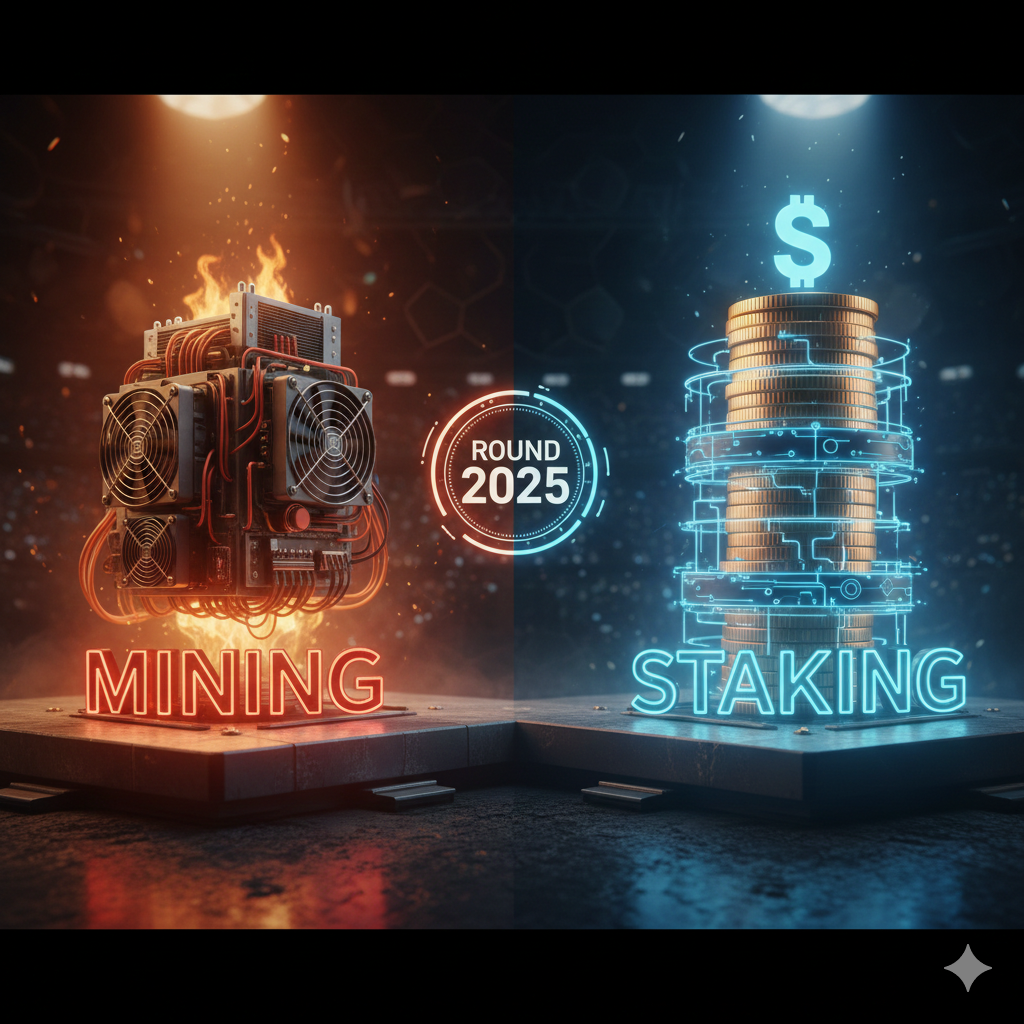
The distinction between mining and staking matters more than most people realize — they involve entirely different economic models, capital requirements, and risk profiles. Mining secures blockchain networks through computational work and electricity; staking secures networks through locked capital. Both generate passive income, but they suit very different investor profiles. Choosing the right one (or the right combination) significantly impacts your passive crypto income strategy.
Side-by-Side: Mining vs Staking Comparison
Side-by-Side: Mining vs Staking Comparison
Capital Requirements
Traditional mining requires $10,000–$100,000+ for competitive ASIC hardware plus electricity and facility costs. Cloud mining reduces this to $15–$1,000+ per contract with no hardware ownership. Staking requires purchasing the staked asset: ETH solo validation requires 32 ETH (~$80,000–$160,000 at various price points); liquid staking (Lido, Rocket Pool) has no minimum; Cardano and Cosmos staking are accessible from $100. Cloud mining provides a low-capital entry point to mining economics without hardware.
Technical Complexity
Traditional mining requires hardware procurement, firmware management, pool configuration, cooling systems, and physical maintenance. Cloud mining eliminates all technical requirements — users purchase a contract and receive daily distributions. Delegated staking (Cardano, Cosmos, Solana) requires wallet setup and a delegation transaction — beginner-friendly with 5-minute setup. Solo Ethereum validator staking requires server administration skills, 24/7 uptime, and key management expertise.
Yield Profile
Mining yields vary dramatically with crypto prices and difficulty adjustments — a 50% BTC price drop cuts mining revenue in half while electricity costs remain fixed. Staking yields are more predictable: ETH at 3.5–5% APY, ADA at 3–4% APY, ATOM at 15–20% APY. Cloud mining offers predictable daily payout schedules based on contracted hashrate. Neither approach eliminates market risk — the underlying asset's price affects dollar-denominated returns for both.
Environmental Impact
Traditional PoW mining consumes significant electricity. Bitcoin's network consumes ~150 TWh/year, comparable to Argentina's national electricity consumption. PoS staking consumes 99%+ less energy — Ethereum's post-Merge energy consumption dropped by 99.95%. Cloud mining's footprint depends on the underlying operations. Some cloud mining providers operate renewable-powered facilities; others use coal-heavy power grids. Environmental due diligence on cloud mining providers matters for ESG-conscious investors.
Deep Dive: Traditional Mining Economics
Deep Dive: Traditional Mining Economics
Bitcoin mining profitability is determined by three variables: BTC price, network difficulty (which adjusts every 2,016 blocks), and electricity cost. An Antminer S21 Pro (200 TH/s) consuming 3,500 watts at $0.05/kWh generates approximately $8–$15 of profit daily at $60,000 BTC. At $0.10/kWh electricity cost (U.S. average), profitability is marginal and may require BTC price above $70,000 to remain cash-flow positive.
The halving cycle fundamentally reshapes mining economics every ~4 years. After the April 2024 halving, the block reward dropped from 6.25 BTC to 3.125 BTC per block — cutting mining revenue in half overnight. Miners with high electricity costs were immediately pushed below breakeven. The surviving miners have the most efficient hardware and the cheapest power (typically renewable energy at $0.03/kWh or below from hydro, solar, or geothermal sources).
Home mining is rarely profitable for retail investors in 2026. The mining industry has become highly institutionalized with data centers in Iceland, Texas, and Kazakhstan operating at commercial electricity rates that retail consumers cannot match. Cloud mining democratizes access to institutional-grade mining economics by pooling capital to operate at commercial scale.
Deep Dive: Staking Economics
Deep Dive: Staking Economics
Ethereum staking economics are well-established: ~3.5–5% APY depending on total ETH staked (more staked = lower individual yields due to dilution). Post-EIP-4844, fee revenue to validators has increased, pushing effective yields toward the higher end. Liquid staking via Lido or Rocket Pool charges a 10% fee on staking rewards (not principal), so effective APY is approximately 3.2–4.5% for retail liquid stakers.
Higher-yield staking opportunities exist on newer networks: Cosmos (ATOM) offers 15–20% APY, Polkadot offers 12–15%, and Solana offers 6–8%. These higher yields reflect higher inflation rates (more new tokens created as rewards) and smaller market capitalizations with correspondingly higher risk. As networks mature and total staked percentages increase, yields typically compress toward 3–6% range.
The 'staking yield illusion': staking yield is paid in the staked asset's own tokens. A 15% APY in ATOM rewards is worth 15% of your ATOM value — but if ATOM's price falls 20%, your dollar-denominated return is negative despite receiving 15% more ATOM. Staking is most valuable when you believe the underlying asset will appreciate or hold value — the yield compounds your existing conviction, but doesn't substitute for asset selection.
Cloud Mining as a Hybrid Strategy
Cloud Mining as a Hybrid Strategy
Cloud mining occupies a unique space between traditional mining and staking: it delivers mining-like daily distributions without requiring hardware ownership, at capital levels accessible to retail investors like staking. The underlying economics are anchored in real computational work (unlike pure yield products that may rely on ponzinomics), but the user experience is as simple as staking delegation.
For XRP specifically, cloud mining is the primary mechanism for passive XRP accumulation with daily distributions — since XRPL uses no mining and staking doesn't apply to XRP directly. Investors who want exposure to XRP's price appreciation while accumulating more XRP through daily distributions have limited alternatives: manual DCA purchases, or cloud mining contracts that distribute XRP daily from mining revenue conversion.
Mining vs Staking FAQs
Best of Both Worlds
Cloud mine XRP daily on MineXrpOnline (mining-style daily payouts, simplicity of no hardware) while staking your ETH or ADA separately. Build two passive crypto income streams today.
Start Mining XRP