The most passionate crypto adopters in the world aren't in Silicon Valley or Manhattan. They're in Venezuela, Nigeria, Argentina, and the Philippines — places where crypto solves problems that are impossible to address through traditional finance. In Argentina, 100%+ annual inflation makes holding pesos financially devastating. In Nigeria, capital controls prevent citizens from accessing USD. In the Philippines, migrant workers pay $45 to send $500 home. In each case, crypto offers a functional solution where traditional finance has failed. Understanding this adoption driver is essential to understanding crypto's long-term value proposition beyond speculation.
Three Major Emerging Market Use Cases
Three Major Emerging Market Use Cases
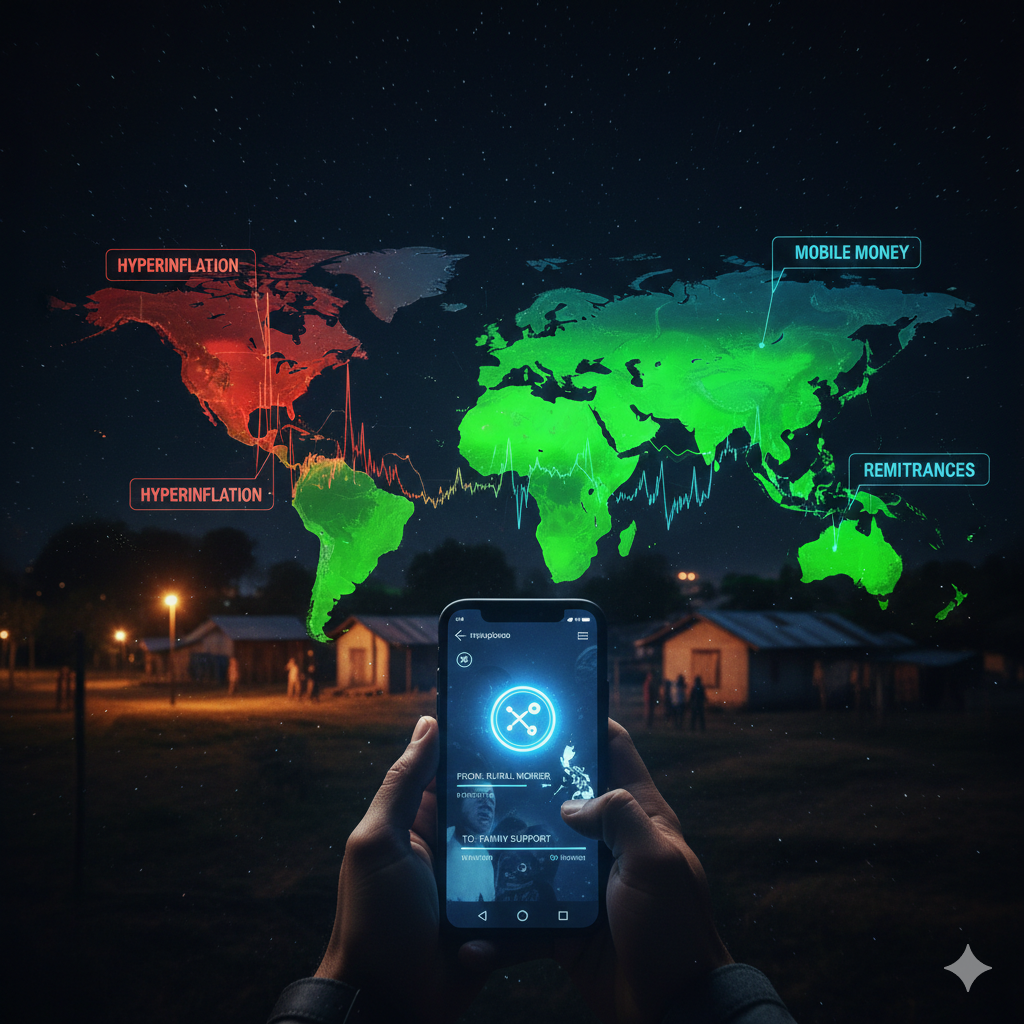
Inflation Protection: Argentina and Venezuela
When a currency loses 50–100% of its value annually (Venezuela: hyperinflation peaked at 100,000% annually in 2018-2019; Argentina: 211% official inflation in 2023, 100%+ in 2024), holding any savings in local currency is financially devastating. Argentines have been the among the world's highest per-capita crypto holders for years — not from speculation but from necessity. Bitcoin and USDC stablecoins function as savings vehicles that preserve purchasing power in ways local banking cannot. Argentina's exchange rate restrictions (el cepo cambiario) mean locals use crypto P2P markets to access the true USD exchange rate, not the artificially controlled official rate.
Remittances: Philippines, Mexico, Africa
Global remittance flows exceed $700 billion annually. Traditional wire transfers charge 5–10% in fees and take 3–5 business days. The Philippine Overseas Foreign Worker (OFW) population of 10+ million workers abroad sends over $36 billion home annually — making it the 3rd largest source of the Philippines' GDP. XRP's On-Demand Liquidity (ODL) payment infrastructure has been active in the Philippines via Coins.ph since 2018, providing near-instant transfers for a fraction of a cent. A worker in Dubai can now send money home in 5 seconds at 99% lower cost than a wire transfer.
Unbanked Populations: Mobile-First Finance
1.4 billion adults globally remain unbanked — without access to basic financial services. In sub-Saharan Africa, only 55% of adults have bank accounts (World Bank 2022). A smartphone enables full crypto wallet access with no credit score, no minimum balance, and no branch requirement. Kenya's M-Pesa demonstrated this with mobile money (now processing more annual transactions than Kenya's GDP), and crypto extends this further with self-custody, borderless transfers, and DeFi access. Mobile crypto wallets serve as savings accounts, payment systems, and international transfer rails for populations traditional banks refuse to serve.
Country-Specific Crypto Adoption Deep Dives
Country-Specific Crypto Adoption Deep Dives
El Salvador's Bitcoin legal tender experiment provides the first national-scale data on crypto as actual currency. Despite early challenges (Chivo wallet technical issues, IMF pressure), the government has continued accumulating Bitcoin, El Salvador's BTC holdings appreciated significantly in 2024, and Lightning Network payments have grown steadily among the tech-literate portion of the population. The experiment proves that national-scale Bitcoin adoption is technically feasible — even if consumer uptake remains gradual.
- ✓Nigeria: largest crypto market in Africa by P2P volume, despite central bank restrictions (2021-2023)
- ✓Argentina: 22% of adults own crypto (2023 Statista) — one of world's highest rates, driven by inflation
- ✓El Salvador: Bitcoin legal tender since Sept 2021, Chivo wallet 3M+ users, $30 government BTC bonus
- ✓Philippines: Coins.ph (XRP ODL partner) has 16M+ registered users, larger than most Philippine banks
- ✓Vietnam: #1 in Chainalysis Global Crypto Adoption Index 2023, driven by young tech-savvy population
- ✓India: 100M+ crypto owners despite regulatory uncertainty — world's largest diaspora sends $125B home
XRP's Structural Advantages in Emerging Markets
XRP's Structural Advantages in Emerging Markets

XRP's ODL network is structurally suited for emerging market remittance corridors: it eliminates the pre-funded nostro accounts that traditional banks require in each destination currency (these nostro accounts cost banks $27 trillion in locked capital globally). For small-market-cap currencies like Philippine Peso, Kenyan Shilling, or Vietnamese Dong, building bilateral correspondent banking relationships is costly — XRP as a universal bridge currency eliminates this entirely.
The regulatory advantage in emerging markets: many developing nations have lighter-touch crypto regulation than the US or EU, enabling faster ODL deployment. Ripple has ODL operations in over 40 countries including across Southeast Asia, Latin America, and growing African corridors. This geographic footprint is not replicable quickly by competitors — each corridor requires local exchange partnerships, local banking relationships, and regulatory approvals that take years to build.
The humanitarian impact is measurable: Ripple's own data shows ODL corridors save recipients an average of 4–7% in fees versus traditional wire transfers. On a $500 monthly remittance, this is $240–$420 more per year reaching the family instead of intermediaries. At scale — 1 billion remittance-dependent people globally — the societal wealth transfer from ODL adoption is measured in hundreds of billions of dollars annually.
Emerging Markets FAQs
Be Part of the Global XRP Adoption Story
Every day more financial institutions adopt XRP for payment corridors serving emerging markets. Mine XRP daily on MineXrpOnline and accumulate the global payment asset as it captures a growing share of a $700B remittance market.
Join the XRP Movement