Depositing stablecoins in Aave for 3% APY is DeFi level 1. Level 5 is using that Aave deposit as collateral to borrow, deploying borrowed funds in a higher-yield strategy, collecting both the base yield AND lending incentives while staying delta-neutral. Advanced yield optimization requires understanding protocol mechanics deeply — and knowing exactly when the added complexity is worth the added risk.
Protocol Stacking: The Advanced Framework
Protocol Stacking: The Advanced Framework

Protocol stacking combines multiple DeFi protocols where the output of one becomes input to the next. Example: deposit USDC into Aave (earning 4% APY + AAVE reward tokens), use Aave position as collateral to borrow DAI at 60% LTV, deploy borrowed DAI into Curve's 3pool (earning 6% APY + CRV rewards), lock earned CRV for veCRV to boost rewards 2.5x. Total effective yield: 8–15% on original capital.
Risk escalates with each stack layer: each protocol adds smart contract risk, liquidation risk on borrowed positions, and reward token price risk. Only stack as many protocols as you can monitor and manage actively. A good rule of thumb is to never borrow more than 50% of your collateral value — this gives substantial buffer before a liquidation event.
Health factor monitoring is critical in any leveraged DeFi position. Aave and Compound show a health factor score (above 1 = safe, below 1 = subject to liquidation). Set up automated alerts via DeBank, Zapper, or APY.vision to notify you when health factor drops below 1.5 so you can top up collateral or repay debt before liquidation.
Automated Yield Vaults
Automated Yield Vaults
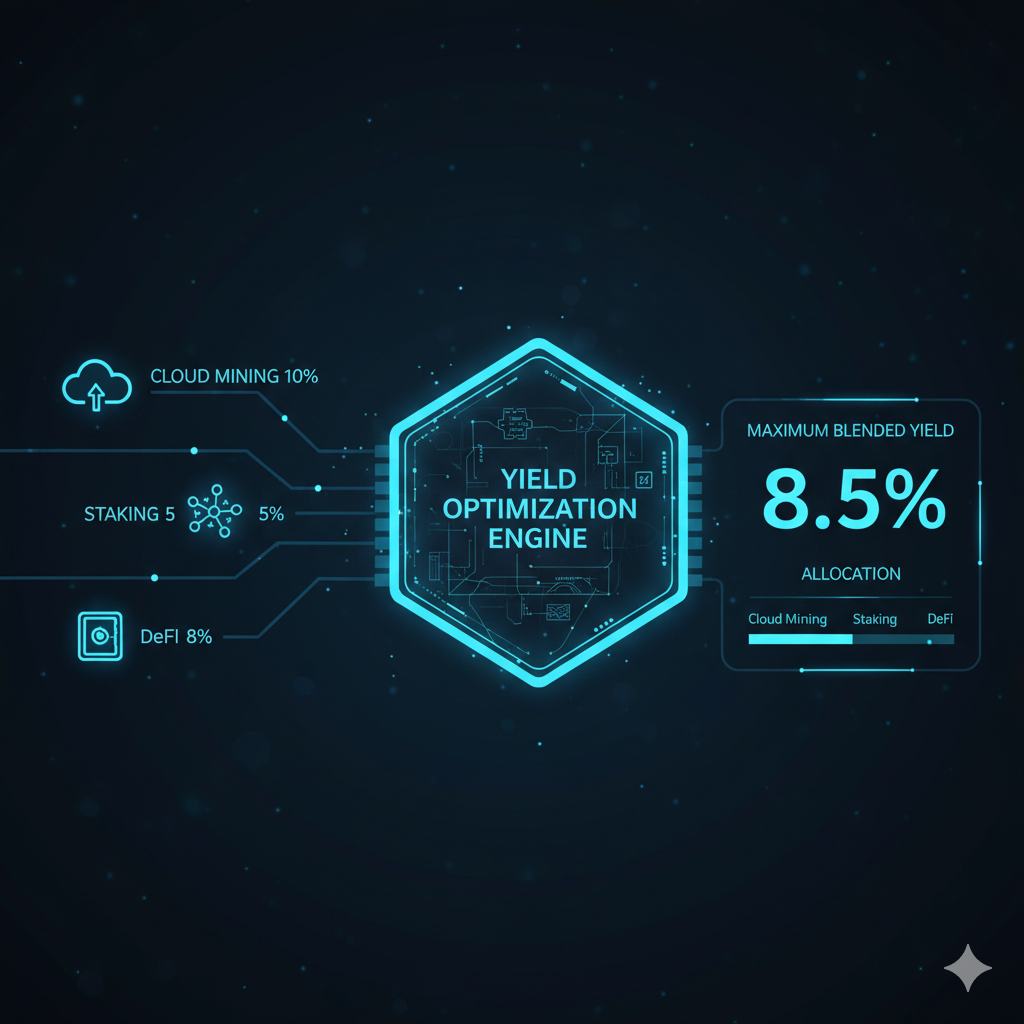
Yearn Finance, Convex Finance, and Beefy Finance automate complex yield strategies into single-deposit vaults. You provide the capital; the vault handles strategy execution, reward harvesting, selling rewards for the base token, and compounding — all automatically with gas costs socialized across depositors.
Vault trade-off: management fees (typically 2% performance fee + small management fee) in exchange for automation, compounding efficiency, and gas optimization. For positions under $10,000, vault fees are usually justified by gas savings alone. For larger positions, you may find it economically worthwhile to manage the strategy yourself.
Convex Finance is a special case: it boosts Curve LP yields by locking CRV on behalf of all depositors, then distributing boosted rewards + CVX token incentives. Depositing a Curve LP token into Convex is one of the most gas-efficient ways to achieve near-maximum Curve rewards without personally managing veCRV locks.
Impermanent Loss: The Silent Yield Killer
Impermanent Loss: The Silent Yield Killer
Impermanent loss (IL) is the opportunity cost of being a liquidity provider compared to simply holding the same assets. When you provide ETH/USDC liquidity and ETH doubles in price, the AMM rebalances your position to sell ETH as it rises — you end up with less ETH than if you held it outright. The 'loss' is the difference between your LP position value and what you'd have had by just holding.
At a 2x price ratio change (one asset doubles, other unchanged), impermanent loss on a 50/50 AMM pool is approximately 5.7%. At 4x it's 20%. At 10x (common in crypto bull markets for volatile assets) it reaches 42%. This is why experienced LPs avoid pairing volatile assets unless trading fee APY is very high (20%+).
The winning strategy for minimizing IL: provide liquidity to stablecoin pairs (USDC/USDT/DAI on Curve) where impermanent loss is virtually zero, or to correlated asset pairs (stETH/ETH, renBTC/WBTC) where prices move together. On these pairs, you collect all the trading fee yield with minimal IL drag.
- ✓Stablecoin pairs (USDC/USDT): near-zero impermanent loss risk
- ✓Correlated pairs (stETH/ETH, WBTC/renBTC): minimal IL due to price correlation
- ✓Concentrated liquidity (Uniswap v3): amplified fees but amplified IL — use with caution
- ✓IL insurance protocols (Bancor v3) exist but add smart contract complexity
- ✓Always calculate break-even fee APY required to offset expected IL before depositing
- ✓Tools: Uniswap v3 fee calculator, Apy.vision, Croco Finance for IL analysis
Cross-Chain Yield Comparison and Optimization
Cross-Chain Yield Comparison and Optimization

The same DeFi protocols are often deployed on multiple chains at different APYs. Aave on Polygon may offer 5% USDC yield while Aave on Arbitrum offers 7% — same protocol, different liquidity depth, different incentive program. Checking the same protocol across all its deployments takes 5 minutes and can meaningfully improve yield.
Layer 2 networks (Arbitrum, Optimism, Base, zkSync) have lower gas costs than Ethereum mainnet, making smaller position sizes viable. An $800 USDC deposit on Ethereum might lose more in gas fees per year than it earns. The same $800 on Arbitrum earns identical protocol yield with negligible gas friction.
Cross-chain bridging risks: bridge contracts are high-value targets and have suffered some of the largest DeFi exploits in history (Ronin $625M, Wormhole $320M, Nomad $190M). Always use the official canonical bridge for major L2s (Arbitrum Bridge, Optimism Bridge) rather than third-party bridges when moving significant capital.
Risk Management Framework for DeFi Yield
Risk Management Framework for DeFi Yield
Never allocate more than 20% of your DeFi portfolio to any single protocol. Smart contract exploits can drain 100% of deposited funds instantly — diversification across protocols is the only meaningful protection. Even audited protocols get hacked: Euler Finance lost $197M in 2023 despite three audits.
The highest-yielding opportunities almost always carry the highest smart contract risk. A brand-new protocol offering 200% APY in the first week is either bootstrapping liquidity with temporary incentives (fine) or a rug pull (catastrophic). Research the team's history, audit reports, TVL trajectory, and time-in-production before depositing significant capital.
Use DeFi Llama (defillama.com) for comprehensive cross-protocol yield comparison and TVL data. Rekt.news maintains a complete database of all major DeFi exploits — reading it is a masterclass in which attack vectors to look out for. Immunefi tracks active bug bounty programs, which signal that protocols take security seriously.
DeFi Yield Optimization FAQs
Start with Simple Yield Before Advanced DeFi
For most investors, simple daily XRP yield through cloud mining is preferable to complex DeFi protocol stacking. MineXrpOnline delivers consistent returns without the smart contract risk, impermanent loss, or active management requirements of advanced DeFi.
Get Simple, Reliable XRP Yield