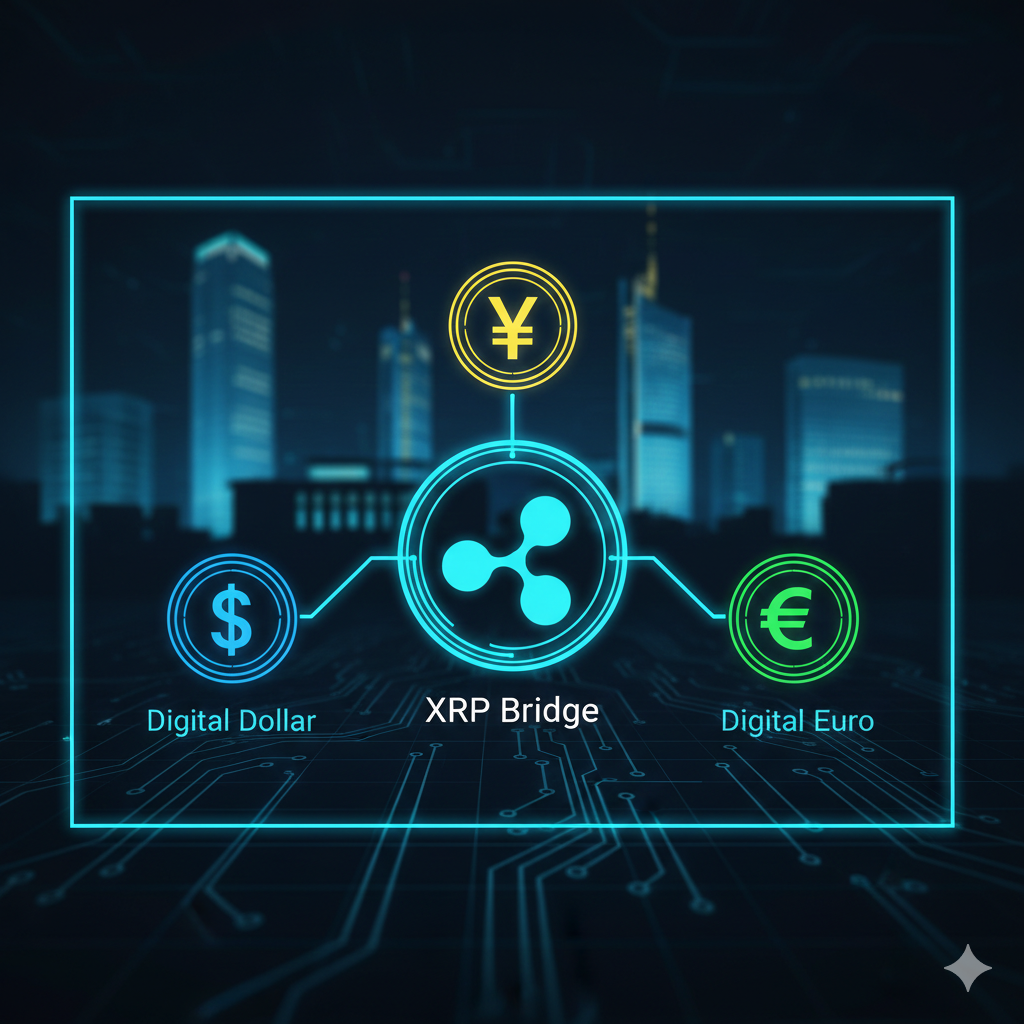
The digital yuan (e-CNY) has over 100 million users. Brazil's Drex is in pilot. The European Central Bank is completing the digital euro design phase. The US Federal Reserve is researching a digital dollar. CBDCs are no longer hypothetical — they're being deployed globally. The question is how this affects crypto.
How CBDCs and Crypto Differ Fundamentally
How CBDCs and Crypto Differ Fundamentally

- ✓CBDCs: issued and controlled by central banks — authorities can reverse transactions or freeze funds
- ✓Crypto: permissionless — no authority can prevent transactions or seize assets without private key access
- ✓CBDCs: potentially programmable (expiry dates, spending restrictions, carbon footprint limits)
- ✓Crypto: neutral — cannot be programmed externally to restrict how users spend their assets
- ✓CBDCs: central monitoring of all transactions by default
- ✓Crypto: pseudonymous on-chain; private with additional privacy tools
XRP's Unique Position: CBDC Bridge and Parallel Asset
XRP's Unique Position: CBDC Bridge and Parallel Asset
Ripple's CBDC Platform provides Central Banks with the infrastructure to issue digital currencies on a private fork of the XRP Ledger. This makes Ripple (and by extension XRP) uniquely positioned: Ripple serves governments with CBDC infrastructure while XRP serves as the neutral bridge asset between those CBDCs.
The compelling vision: when the digital euro needs to settle transactions with the digital rupee, XRP can serve as the neutral intermediary — neither government needs to trust the other's CBDC, but both can trust XRP's deterministic settlement finality and 3-5 second clearing time.
The Privacy Concern: Why CBDCs Boost Crypto Demand
The Privacy Concern: Why CBDCs Boost Crypto Demand

Counterintuitively, CBDC rollouts may increase demand for Bitcoin and XRP as privacy-preserving alternatives. As digital yuan restrictions and surveillance capabilities become apparent to Chinese citizens, crypto adoption in that population has grown — driven by demand for financial sovereignty that CBDCs cannot provide.
The same dynamic is likely in Western markets: as CBDCs eliminate the last vestiges of cash-like financial privacy, demand for genuinely censorship-resistant digital assets (Bitcoin) and global utility assets (XRP) grows among citizens who value financial autonomy.
CBDC vs Crypto FAQs
Own the CBDC Bridge Asset
As CBDCs roll out globally, XRP's role as the neutral settlement bridge between them becomes more valuable. Accumulate XRP daily through MineXrpOnline while the CBDC era unfolds.
Start Accumulating the Bridge Asset